Your business is moving KES 5M+ a month in revenue. You have operations spanning Nairobi and beyond, a logistics team packing and shipping orders daily, and suppliers calling about payments. The last thing you need is another “marketing expense.”
Meta keeps hiking ad prices, and your WhatsApp broadcasts have probably made half your contacts mute you already. Meanwhile, your competitors are getting something you’re not: free traffic.
Think about it. When someone in Nairobi types “where can I buy (your product) near me” into Google, does your site show up? If it doesn’t, that’s a missed sale, in other words, a customer who ends up at someone else’s shop.
As an agency offering SEO services in Kenya, we’ve spent years helping local SMEs and e-commerce stores plug this leak. We’re not going to talk about abstract SEO theory, but rather borrow from our own tried-and-tested OnMedia SEO playbook. We’ll show you homepage SEO tips you can implement today to get Google to treat your e-commerce site like the most relevant store in town, without having to spend a fortune renting audiences you never actually own.
1. Optimize Your Title Tag for Kenya Intent
Open your website on your phone right now. Look at the browser tab at the top. What does it say?
If it says “Home,” “Welcome,” or just your company name, you’ve already lost half the battle. That little tab text, called the title tag, is your first and best chance to tell Google exactly who you are and where you operate.
Your homepage title tag is one of the most important pieces of SEO real estate you control. Google reads it first. Customers see it first in search results. And in Kenya, what they’re looking for is surprisingly specific.
Here’s what we’ve noticed after years of optimizing local sites: Kenyans don’t search the way global audiences do. We’re incredibly precise about what we want and exactly where we want to buy it.
When someone’s car breaks down in Roysambu at 6 PM, they don’t search for “mechanics.” They type “mobile mechanic near Roysambu.” Their location isn’t an afterthought; it’s the whole point of the search.
In SEO terms, this is called Local Search Intent, and it changes everything about how you should structure your homepage.
So how do you capture someone stranded in Roysambu, or a homeowner in Kilimani looking for tiles, or an office manager in Westlands needing furniture delivered TODAY? It starts with that browser tab.
Here’s a simple formula that works for Kenyan businesses:
Primary Keyword (+ Secondary Keyword) + Location | Brand Name
Example: Office Furniture and Ergonomic Chairs in Nairobi | YourBrand
Let’s assume you run an electronics shop in the CBD. Your current title might be “XYZ Electronics – Best Deals.” But that tells Google nothing useful.
A stronger title would be: “Smartphones and Laptops in Nairobi | M-Pesa Accepted | XYZ Electronics.” See the difference? The latter version tells Google three critical things: what you sell, where you operate, and how customers can pay. It also gives the person searching exactly what they need to click through.
Now, there are a few common mistakes you’ll want to avoid as you implement this:
- Keyword stuffing: Do not write “Phones Nairobi, Phones Kenya, Cheap Phones, Buy Phones.” Google treats this as spam.
- Dropping your brand: Always include your brand name at the end so customers who find you on social can locate you on Google.
2. Fix the Mobile Speed Gap
Most of your customers are browsing on Safaricom or Airtel networks. Sometimes the connection is great. Sometimes it’s not. If your homepage takes more than three seconds to load on their phone, they’re gone. They don’t wait. They go to the next shop.
And here’s the part that hurts: Google knows this and uses what we call Mobile-First Indexing, meaning it ranks sites based on the mobile experience. So, if your site is slow, you’re invisible.
The fix isn’t complicated. Simply:
- Compress images: Oversized banner images are one of the most common culprits on Kenyan sites. Aim for homepage images under 150KB.
- Use WebP format: Convert JPEGs and PNGs to WebP for smaller file sizes without visible quality loss.
- Reduce unnecessary scripts: Third-party chat widgets and tracking scripts delay your initial page load. Audit what is running on your homepage.
Quick pro tip? Run your URL through Google PageSpeed Insights (free). If your mobile score is below 50, run your homepage images through a compressor. It takes minutes with a tool like TinyPNG, which also happens to be free.
3. Make Your Trust Signals Visible
Trust is the currency of Kenyan e-commerce. Nobody is sending M-Pesa to a PO Box. They want to know there’s a physical place, a real person, a number they can call if something goes wrong.
Google’s E-E-A-T framework (Experience, Expertise, Authoritativeness, Trustworthiness) rewards sites that demonstrate credibility through visible signals. So, your homepage needs to scream “we are legitimate” from the moment it loads.
Make sure your homepage includes:
- Physical address: Add your office or warehouse location to your footer. If you operate in Industrial Area, Westlands, Ruiru, Kasarani, say it clearly.
- Phone number: A visible +254 number reassures both customers and Google that you are a real Kenyan business.
- Payment method logos: Display M-Pesa, Visa, and Mastercard logos near your call-to-action or checkout buttons.
- WhatsApp button: A floating WhatsApp button shows that a real person is reachable if they have questions.
Why this matters for rankings: When your homepage includes a Nairobi address and a local phone number, Google can better associate your site with local search results.
Struggling with SEO? We audit Kenyan businesses every Tuesday and Thursday at 2 PM in our SEO Power Hour. See exactly why you are not ranking and get 3 quick wins you can act on today. Register for SEO Power Hour
4. Map Your H1 and H2 Tags to Revenue Keywords
Many Kenyan business websites use their H1 for phrases like: “Welcome to Our Website” or the cliche “Quality You Can Trust.” These might make sense to the human eye, but they have no search value and tell Google nothing about what you sell.
A better Approach:
Ensure your H1 states exactly what you sell and where you operate.
Example:
Bad H1: Welcome to Global Logistics Kenya.
Good H1: Reliable Last-Mile Delivery and Warehousing in Nairobi.
Recommended homepage header structure:
H1: Primary keyword + location (e.g., Solar Panel Installation in Kenya)
H2: Key categories (e.g., Residential Solar Solutions, Commercial Backup Systems)
H3: Supporting benefits (e.g., Pay via M-Pesa, 24-Month Warranty)
Some common mistakes to avoid:
- Multiple H1 tags: Your homepage should have only one H1. Using more than one can confuse Google about your primary topic.
- Vague language: Phrases like “Solutions for you” are invisible to search engines. Be specific. Use something like “Tiling solutions for Nairobi contractors” instead.
5. Add Local Business Schema Markup
Here’s something most Kenyan sites miss: Google is getting smarter by the day, but it still needs you to spell out some things.
There’s a thing called schema markup. Ignore the technical name. Just think of it as handing Google a digital business card. It tells Google your address, your phone number, your hours, and links to your Instagram and Facebook.
Two schema types are particularly useful:
- LocalBusiness Schema: Tells Google your address, phone number, and business hours.
- Organization Schema: Links your social media profiles (Facebook, Instagram, LinkedIn) to your website so Google knows they belong to the same entity.
Because many Kenyan businesses have not implemented schema, adding it is a fast way to make your search results more informative and visually appealing. And listings that stand out often earn higher click-through rates.
A snippet from OnMedia’s SEO playbook: Use the TechnicalSEO.com Schema Generator to create LocalBusiness markup. Paste the code into your homepage header or use plugins like Rank Math if you’re on WordPress.
6. Use Your Homepage to Pass Authority to Key Categories
Your homepage is usually the strongest page on your site because it receives the most external links. Unfortunately, most businesses waste this opportunity by only linking to “About Us” or “Contact” pages.
A better strategy is to add a Featured Categories section. Instead of having one “Shop” button, link directly to important pages using keyword-rich anchor text.
Examples:
“Buy Inverters in Kenya”
Or
“View Construction Equipment in Nairobi”
Why does this matter?
Simple: If your highest-margin product category is heavy-duty generators, that page should have a direct link from your homepage using the keyword you want it to rank for. This signals to Google that the page matters.
A few things to avoid while at it:
- Broken links: Links leading to 404 pages hurt both user experience and rankings. Audit them regularly.
- Vague anchor text: Replace “Click Here” with clear, descriptive text like “Browse our Nairobi warehouse inventory.”
If you’re unsure whether your site structure supports search visibility, working through a detailed E-commerce SEO checklist can help you identify missing elements like internal links, product schema, and category optimization.
7. Optimize for Neighborhood-Level Searches
As mentioned earlier, search behavior in Kenya is becoming increasingly location-specific. People often search for phrases like:
- “Hardware store near me”
- “Electronics shop in Westlands,”
- “Delivery services in Syokimau”
To appear in these searches, your homepage should mention the specific neighborhoods and areas you serve.
What to add:
- A service area section: List the estates and neighborhoods where you operate. Think Kilimani, Kileleshwa, Langata, Thika Road, Kasarani, and so on.
- An embedded Google Map: A map of your physical location helps Google verify your local presence and strengthens local SEO signals.
Get your free Google Visibility Score: a 15-minute analysis showing how visible you are versus competitors, your top keyword opportunities, and 3 quick wins for your site. Get Your Free Score.
Frequently Asked Questions
How long does SEO take to work in Kenya?
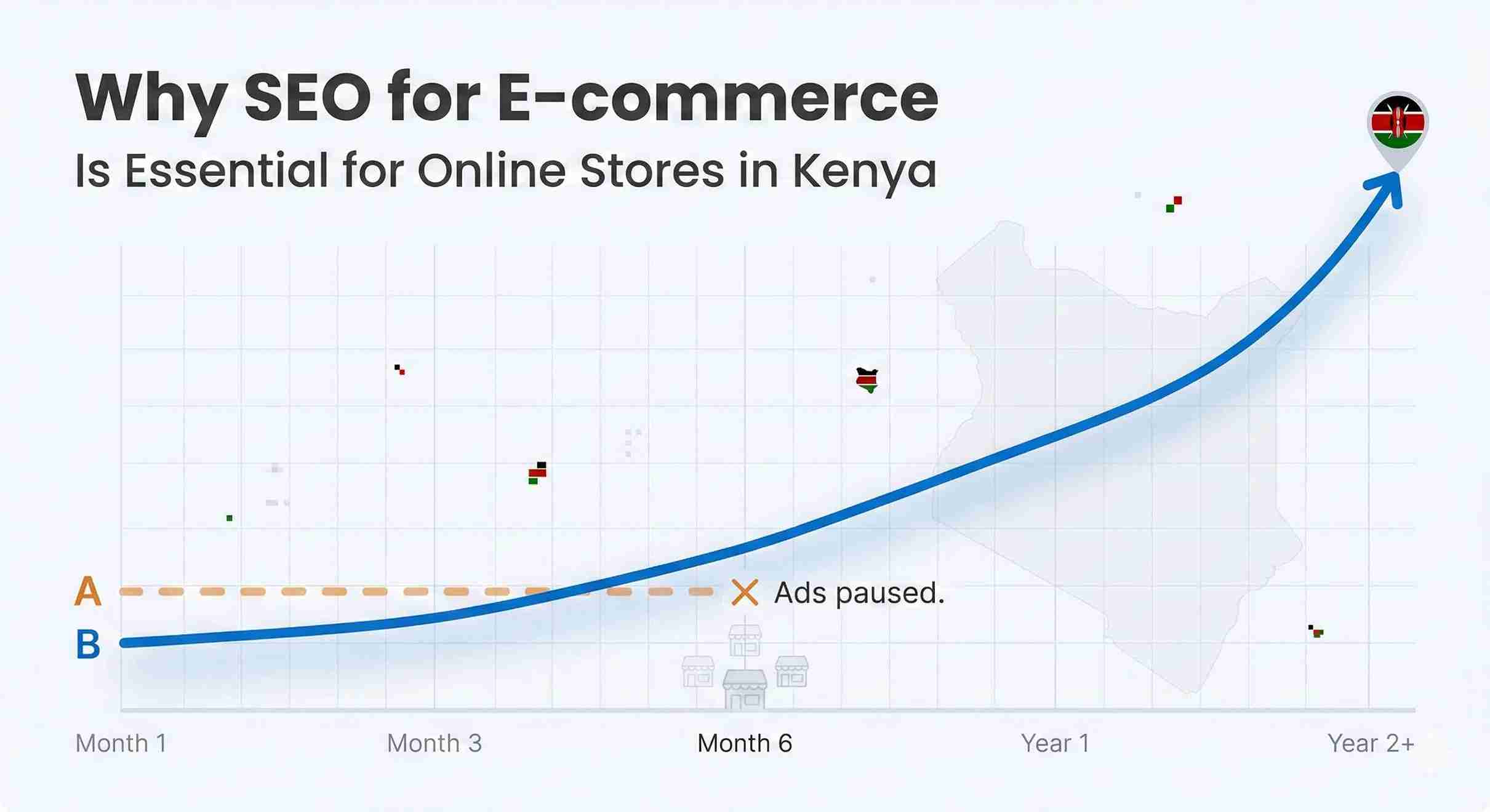
Unlike Google Ads, which deliver traffic immediately, SEO builds gradually.
For an established site already generating KES 5M per month, you can expect to see homepage ranking improvements within 4 to 8 weeks.
Ranking for competitive category keywords typically takes 4 to 6 months.
Can I do SEO myself, or do I need an agency?
You can implement the pro tips and quick wins in this guide yourself.
But to compete with e-commerce giants like Jumia, you will need technical SEO, backlink building, and a long-term content strategy. If your time is more valuable than the cost of professional help, outsourcing can be a smarter investment.
What is the difference between SEO and Google Ads?
Google Ads is rented traffic. The moment you stop paying, the traffic disappears.
SEO builds owned traffic. Over time, it becomes an asset that reduces your customer acquisition cost.
Why does my website not appear on Google when I search my own brand name?
This usually points to a technical issue.
Either your site has accidentally been set to “noindex,” or your homepage is missing the basic metadata that Google needs to verify and index your business.
Do I need a new website to improve my SEO?
Rarely.
Most sites built on Shopify, WooCommerce, or similar platforms are already capable of ranking well. What you probably need is a better strategy for the website you already have. If you’re still deciding which system to use, choosing the best e-commerce platform for SEO can make future optimization much easier.
Turn Your E-Commerce Store Into a Consistent Source of Customers
Your website should be the hardest-working member on your payroll. If Google isn’t sending you traffic, then your website is underperforming. And every day it underperforms, your competitors are taking customers you could have had.
Implementing these homepage SEO tips isn’t about tricking Google. It’s about making it painfully obvious to Google that you are the best option for someone in Nairobi or whichever location looking for what you sell.
So, start this week.
- Change that browser tab text.
- Compress your biggest images and improve mobile speed.
- Put your address and phone number in the footer, as well as the payment method logos if applicable.
- Add a list of neighborhoods you serve.
If you’d rather focus on running your business while we handle this, that’s what OnMedia is here for. But whether you call us or not, start today. Your margins will thank you.