

Who knew a day would come when a bot could go over to Jumia and order your favourite dress, or browse Eastnat for your favourite honey pack, without you lifting a finger?
That day is here. Well, almost.
Google officially has documented something called Google-Agent. It is not a new search crawler. It is an AI that a real person sends to websites with a specific task. Book the consultation. Find the price. Check if the product is in stock. Complete the purchase.
The user sits back. The agent does the browsing.
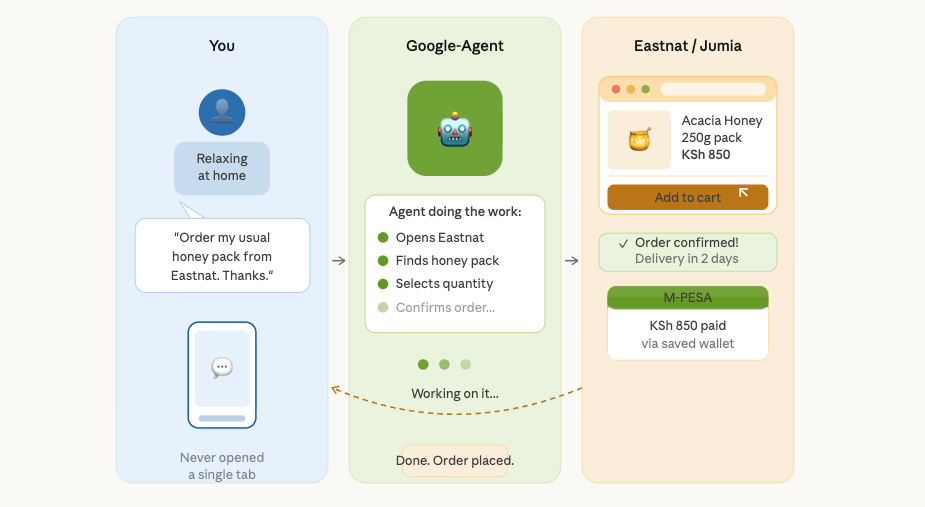
This changes something important for anyone running a business in Kenya with an online presence.
The question is no longer just whether your website shows up in search. It is whether your website can actually be used by an AI acting on someone else’s behalf.
So What Exactly Is Google-Agent?
Think about how Google has always worked.
You type a question, Google sends a crawler to index websites, and then it shows you a list of results. That crawler, called Googlebot, is looking for content. It reads. It ranks. That is it.
| Property | Google-Agent |
| What it is | A user-triggered AI agent, not an automatic crawler |
| When it visits | Only when a real person gives it a specific task |
| What it wants | To complete an action — book, buy, find, compare |
| Does it follow robots.txt? | No. It acts as a proxy for a human user |
| Currently available | US only (Google AI Ultra). Global rollout expected |
Google built this for a product called Project Mariner, an AI agent that runs on Gemini 2.0. You tell Mariner something like: ‘Find me a physiotherapist in Karen who has slots this week and charges under 3,000 shillings.’ Mariner opens websites, reads them, navigates menus, fills forms, and comes back with a confirmed booking. You never open a single tab.
Right now this is only available in the US. But Google has already documented it globally, which means the rollout is coming. And the businesses that will benefit are the ones whose websites are already ready for it.
Why This Is a Different Problem From Normal SEO
Traditional SEO is about being found. You write the right content, you earn the right backlinks, and when someone searches for what you offer, your site appears.
Google-Agent does not care about any of that in the same way. It is not browsing. It is executing.
Imagine a customer sends their AI assistant to book a service from your business.
The agent lands on your website and cannot find your pricing because it lives inside a PDF. Or your booking form does not load properly on mobile. Or your service areas are only mentioned in a paragraph buried on your About page with no structured labelling.
The agent gives up. It moves to the next business. And your potential customer never even knows you existed.
This is the new gap. Not visibility. Usability.
Who Gets Hit Hardest in Kenya
Service businesses are the most exposed. Lawyers, clinics, accountants, mechanics, salons, tutors. Any business that relies on a client taking a specific action to engage. If an AI agent cannot find a clear path to that action, you lose the lead before you ever got it.
E-commerce businesses are next.
If your product prices load slowly, or your checkout process has too many unnecessary steps, or your stock availability is not clearly labelled, the agent cannot complete the purchase. It will move to whoever built their store with clarity in mind.
And then there are blogs and information sites. If your whole value is explaining something, like how to file for a business permit or how to calculate NHIF contributions, an AI can just summarise your article and give the user the answer without them ever visiting your site. You get zero credit, zero traffic, zero revenue.
The only way out of that last one is to offer something the AI cannot summarise. A tool. A calculator. A form. Something that requires the user to actually be on your site.
What Makes a Website Ready for This
You do not need to rebuild your entire website. But a few things matter a great deal now.
| Action | What it means |
| Structured data (Schema) | Add JSON-LD markup for prices, services, service areas, opening hours, and booking availability. This is the single highest-impact action. |
| Site speed | Google-Agent is impatient. Pages that load slowly or hide content behind heavy JavaScript are harder to use. Run a speed audit. |
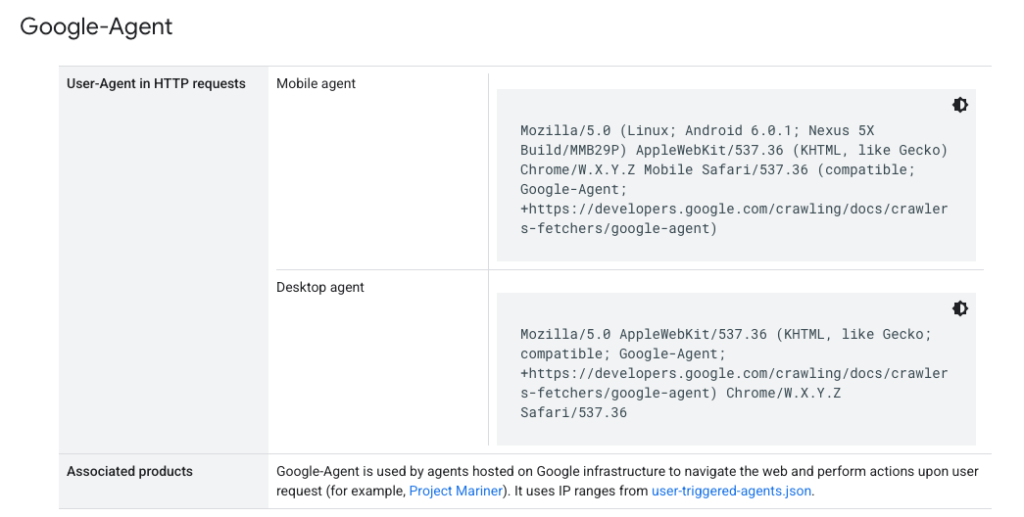
| Firewall / WAF settings | If your site uses bot protection, ensure it recognises and permits the Google-Agent user-agent string. |
| Conversion paths | Audit the journey from landing page to completed action. Is it obvious? Is it fast? Could a machine follow it without guessing? |
| Content strategy | Move from pure information to utility. Don’t just explain — offer tools, calculators, booking widgets, or forms that require being on your site to use. |
Structured data
This is code that labels your content so machines can read it precisely. Your prices, your service areas, your opening hours, your booking availability. Without it, an AI agent visiting your site is like a customer walking into a shop with no price tags and no staff. It has no idea what you offer or how to proceed.
Site speed and clean structure
AI agents are not patient. Pages that load slowly or bury their most important information behind heavy animations or unnecessary clicks will lose the agent before it even gets started. The path from landing on your site to completing an action should be as short and obvious as possible.
Bot access
Some Kenyan businesses use aggressive firewall settings to block bots from scraping their content. That made sense for certain threats. But Google-Agent looks like a real user, and if your firewall blocks it, you are effectively turning away a customer who sent their AI to shop with you. You need to make sure your settings specifically allow it.
The Kenya Angle Nobody Is Talking About
Most of the global coverage on Google-Agent is written for the US or European market. But honestly, this shift might benefit Kenyan consumers more than anyone.
Think about what mobile browsing actually costs here. Data is not cheap. Opening five different websites to compare prices, each one loading slowly, each one asking you to accept cookies and sign up for a newsletter before you can see anything useful, is genuinely expensive in both time and money.
Asking an AI agent to do all of that in one command and come back with the best option is not just convenient. It is economical. Kenyan consumers will adopt this faster than most markets because it solves a real problem.
The businesses that are ready will get that traffic. The ones that are not will become invisible, not because they did not show up in search, but because their websites could not be used when it mattered.
What This Means for Your Brand
We talk a lot about being found. That is still important. But being found is the door. Being usable is the room.
A beautiful website that an AI cannot navigate is the digital equivalent of a locked shop with a nice sign. People can see you are there. They cannot get in.
The brands that will grow over the next few years are the ones building digital presence that works at every level.
Works for humans browsing on their phones. Works for AI agents acting on their behalf. Works as a complete, connected system.
If you are not sure whether your website is ready for this, that is the first thing worth finding out. Start with a proper audit. Look at your structured data, your page speed, your conversion paths. And fix the gaps before the rollout arrives.
Because when it does, and it will, the window to prepare will already be closed.
But as I always advise, don’t sweat or stress over AI optimization if your traditional SEO is poor. Answer Engine Optimization (AEO) complements SEO — it doesn’t replace it.
If you’re wondering how your website is placed to perform in this shift, you can start with a free SEO Audit from us.
