If you’ve been researching how to sell online, you’ve probably come across our guide on e-commerce platforms for Kenyan entrepreneurs. You know your options from a local perspective, as well as the cost and technical requirements for each.
But there’s one question that guide didn’t answer: Which platform will actually help my business get found on Google?
Here’s the truth that platform sales pages won’t tell you: Not all e-commerce platforms are built equal when it comes to search engine optimization. Some give you the tools and control needed to compete in search rankings. Others quietly limit your visibility. And a few don’t involve Google at all.
This article will help you pick the best e-commerce platform for SEO from the five realistic options available to Kenyan entrepreneurs: Shopify, WooCommerce, Jumia, Instagram Shopping, and custom-built websites.
If organic traffic is part of your growth strategy, read carefully before you commit.
What Makes an E-commerce Platform SEO-Friendly? The Five Pillars of E-commerce SEO in 2026
Before we rank the options, let’s establish what actually makes a platform SEO-friendly today. These five factors determine whether your store will thrive or disappear in Google’s AI-powered search results.
Pillar 1: Technical Foundation & Crawlability
Before any other SEO work matters, search engines must be able to discover, crawl, and index your pages. If your platform blocks or hinders this process, you’re invisible on Google regardless of content quality.
Key factors to evaluate:
- Sitemap generation: Does the platform automatically create and update XML sitemaps?
- Robots.txt access: Can you control what search engines crawl?
- Canonical tags: Does the platform handle duplicate content automatically?
- HTTPS/security: Is SSL included and properly implemented?
Technical SEO ensures search engines can find, crawl, and index your website. It prevents critical issues like slow page speed, duplicate content, and wasted crawl budget.
Pillar 2: Content Flexibility & On-Page Optimization
Google now prioritizes content that demonstrates expertise and matches search intent. Product pages must behave like “mini-blog posts” with detailed descriptions, comparison tables, sizing guides, and customer reviews.
Key factors to evaluate:
- Title and meta description control: Can you edit these for every page?
- URL customization: Can you create clean, keyword-rich URLs without forced parameters?
- Content depth: Can you write comprehensive product descriptions (500+ words) and add buying guides?
- Blogging capability: Can you publish articles that build topical authority?
High-ranking product pages in 2026 include detailed descriptions, comparison tables, video tutorials, sizing guides, customer reviews, and real-life usage examples.
Pillar 3: User Experience & Core Web Vitals
Why it matters: Google explicitly uses page experience signals as ranking factors. With mobile-first indexing, your mobile version determines your rankings.
Key factors to evaluate:
- Page speed: LCP under 2.5 seconds, FID under 100ms, CLS under 0.1
- Mobile responsiveness: Is mobile experience truly optimized, not just “mobile-friendly”?
- Core Web Vitals compliance: Does the platform help you meet Google’s performance thresholds?
- CDN and caching: Does the platform include content delivery networks for speed?
If your site lags or crashes on mobile, Google buries you. And with over 60% of ecommerce traffic now coming from mobile devices, that can cripple your store.
Pillar 4: Schema Markup & Rich Results
In 2026, schema markup is no longer optional. Google uses structured data to understand your products and display rich results that dramatically increase click-through rates.
Key factors to evaluate:
- Product schema: Can you easily add markup for price, availability, and reviews?
- Review schema: Does the platform support star ratings in search results?
- FAQ schema: Can you add FAQ sections with proper markup?
- Schema flexibility: Can you add custom schema types as needed?
Schema markup lets you tag key product details like size, price, condition, and stock, which helps Google understand your product more clearly. It doesn’t guarantee rich results, but it’s required to qualify for features like product stars or stock badges. When applied correctly, it can improve your chances of appearing more prominently in search results
Pillar 5: Authority Building & EEAT
Google now strongly follows EEAT: Experience, Expertise, Authoritativeness, Trustworthiness. If your website doesn’t clearly show who is behind the content and why they are qualified, it becomes difficult to rank.
Key factors to evaluate:
- EEAT signals: Can you add author bios, cite sources, and display credentials?
- Link-worthy content: Does the platform enable you to create content that naturally earns backlinks?
- Review integration: Does the platform support authentic customer reviews? Google trusts User-Generated Content (UGC) as a ranking signal. Keep in mind that Google trusts users more than sellers. Fake or copied reviews can actually hurt SEO.
- Brand building: Does the platform help you build a distinct brand presence?
Ranking the Best E-commerce Platforms for SEO in Kenya: From Worst to Best
Now let’s evaluate each platform against these five pillars.
5. Instagram/Facebook Shopping
Instagram/Facebook Shopping’s SEO capability is pretty much non-existent. Here’s how it performs across the five pillars of e-commerce:
- Technical Foundation: Zero. Instagram content lives inside Meta’s walled garden. Google cannot crawl or index your product tags. There are no public URLs for search engines to discover.
- Content Flexibility: None. You cannot edit meta titles, descriptions, or URLs. Your product descriptions exist only within the app.
- User Experience: Platform-controlled. You have no control over load times, mobile responsiveness, or Core Web Vitals.
- Schema Markup: Impossible. Instagram doesn’t support structured data of any kind.
- Authority Building: You’re building Meta’s authority, not yours. Every interaction strengthens their platform, not your brand.
Verdict: Instagram Shopping works for discovery, not SEO. Instagram is a sophisticated traffic driver, not a search engine play.
4. Jumia Seller Account
Jumia Seller Accounts offer limited SEO value because you’re essentially renting visibility on their platform. Here’s how it performs across the five pillars of e-commerce:
- Technical Foundation: Low. Jumia handles everything, but you control nothing. Your products live on Jumia.co.ke, which has a strong domain authority, but you cannot access sitemaps, robots.txt, or canonical tags.
- Content Flexibility: Minimal. You can write product descriptions, but cannot edit URLs, meta titles, or meta descriptions. Your content is confined to Jumia’s template structure.
- User Experience: Platform-controlled. Jumia manages site speed and mobile optimization, and in Kenya, they’ve heavily invested in mobile-friendly design.
- Schema Markup: Implemented by Jumia, not you. Your products may appear with rich snippets, but the structured data belongs to the platform.
- Authority Building: This is the critical weakness. You’re building Jumia’s authority, not your own. If Jumia changes its platform or suspends your account, your “SEO” disappears overnight. Every backlink points to Jumia, not your brand.
Verdict: Jumia has successfully leveraged SEO to dominate searches like “online shopping in Nairobi,” but you’re merely renting that visibility. Good for short-term sales. Terrible for building long-term organic traffic assets.
3. Shopify
Shopify provides a solid SEO foundation, but there’s a ceiling for more advanced optimization. Here’s how it performs across the five pillars of e-commerce:
- Technical Foundation: Strong basics. Shopify automatically generates sitemaps, handles canonical tags, and includes SSL certificates. However, you cannot modify server-level files, and URL structures include forced elements like /products/ and /collections/ that cannot be removed.
- Content Flexibility: Good for beginners, limited for experts. You can edit meta titles and descriptions easily. Shopify includes a blogging engine, but it’s basic compared to WordPress. Advanced content marketing may hit limitations.
- User Experience: Excellent baseline. Shopify offers global CDN and reliable hosting. However, app bloat can slow your site, and backend access is limited. In Kenya, Shopify works reasonably well, but transaction fees and app costs add up.
- Schema Markup: Shopify provides basic product schema automatically, enabling rich snippets for price and availability. Advanced schema, like FAQ, HowTo, or reviews, often requires paid apps or custom code.
- Authority Building: You can build your brand’s authority within Shopify’s template constraints. The platform doesn’t restrict backlink acquisition, but content marketing tools are limited.
Verdict: Shopify stores can perform well if they build comprehensive pages, but many underperform due to thin content, generic collections, and weak internal linking. For Google’s AI-driven search, your pages need to answer buyer questions directly.
Overall, Shopify is Ideal for beginners seeking decent SEO with minimal technical effort, but advanced users will eventually hit a ceiling.
2. Custom-Built E-commerce Website
Custom-built e-commerce websites offer the highest SEO potential, but results depend entirely on expertise. Here’s how they perform across the five pillars of e-commerce:
- Technical Foundation: Complete control. You can architect every aspect of crawlability, indexation, and site structure.
- Content Flexibility: Unlimited. Any content type, URL structure, or publishing workflow is possible.
- User Experience: Variable. Properly developed sites can achieve excellent Core Web Vitals and mobile performance. The reverse is true for poorly developed websites.
- Schema Markup: Fully customizable. Any type of structured data can be implemented with developer support.
- Authority Building: Maximum potential. Every backlink, piece of content, and trust signal belongs to your brand.
Verdict: Custom-built sites offer theoretically unlimited SEO capability. In practice, success depends on skilled development and strategic execution. They allow full control over structure, content, schema, and authority, but require building trust and backlinks from scratch. For most Kenyan businesses, this level of investment is only justified if your SEO goals or technical requirements cannot be met by platforms like WooCommerce.
1. WooCommerce
WooCommerce offers the best balance of SEO control and practicality for long-term growth. Here’s how it performs across the five pillars of e-commerce:
- Technical Foundation: Full control with the right hosting. You can optimize permalinks, robots.txt, canonical tags, and server settings to achieve excellent crawlability and Core Web Vitals.
- Content Flexibility: Unmatched. WordPress allows unlimited blogs, buying guides, FAQs, and other content to build topical authority. SEO plugins like Yoast and Rank Math provide real-time optimization feedback.
- User Experience: Controllable. Page speed depends on hosting and optimization. Properly configured WooCommerce sites can outperform Shopify.
- Schema Markup: Comprehensive and easy. Essential product schema is generated automatically, and advanced schema types (FAQ, HowTo, local business) can be added without coding.
- Authority Building: Maximum control. Every blog post, backlink, and customer review builds your brand’s authority and EEAT signals.
Verdict: WooCommerce is the clear winner for businesses serious about long-term organic growth. It combines the content power of WordPress with full technical control, allowing unlimited SEO potential.
Proper hosting and optimization let you achieve excellent page performance, and flexible schema and content options make it adaptable to AI-driven search. Every asset you create directly strengthens your brand’s authority in Google’s eyes.
The Final Ranking: Quick Comparison Table
| Platform | Technical Foundation | Content Flexibility | UX & Core Web Vitals | Schema Markup | Authority Building | Overall |
| Instagram Shopping | ⭐ | ⭐ | ⭐ | ⭐ | ⭐ | Nonexistent |
| Jumia | ⭐⭐ | ⭐⭐ | ⭐⭐⭐ | ⭐⭐⭐ | ⭐ | Low (Rented) |
| Shopify | ⭐⭐⭐⭐ | ⭐⭐⭐ | ⭐⭐⭐⭐ | ⭐⭐⭐ | ⭐⭐⭐ | Solid Foundation |
| Custom-Built | ⭐⭐⭐⭐⭐ | ⭐⭐⭐⭐⭐ | ⭐⭐⭐ | ⭐⭐⭐⭐⭐ | ⭐⭐⭐⭐⭐ | Unlimited |
| WooCommerce | ⭐⭐⭐⭐⭐ | ⭐⭐⭐⭐⭐ | ⭐⭐⭐⭐ | ⭐⭐⭐⭐⭐ | ⭐⭐⭐⭐⭐ | Best Overall |
Which Platform Should YOU Choose for SEO in 2026?
Here’s the honest framework based on your situation:
- If you’re testing products with a minimal budget: Start with Instagram Shopping, but understand you’re building zero SEO assets. Plan to migrate to a real website once you validate demand.
- If you want immediate sales and don’t care about long-term assets: Jumia works. You’ll get visibility from their domain authority. Just know you’re renting, and your rankings disappear if you leave.
- If you’re non-technical with a limited budget and need a store fast: Shopify gives you decent baseline SEO. You’ll rank okay, but you’ll hit a ceiling eventually. Accept that limitation going in .
- If you have unique requirements and KES 1M+ monthly revenue: Custom development can achieve anything if you hire SEO-aware developers and budget for ongoing maintenance.
- If you’re serious about building a long-term brand that dominates Google search: WooCommerce is the best e-commerce platform for SEO. The combination of WordPress content power, full technical control, and proven SEO plugins means no ceiling on your organic growth.
Your Next Step
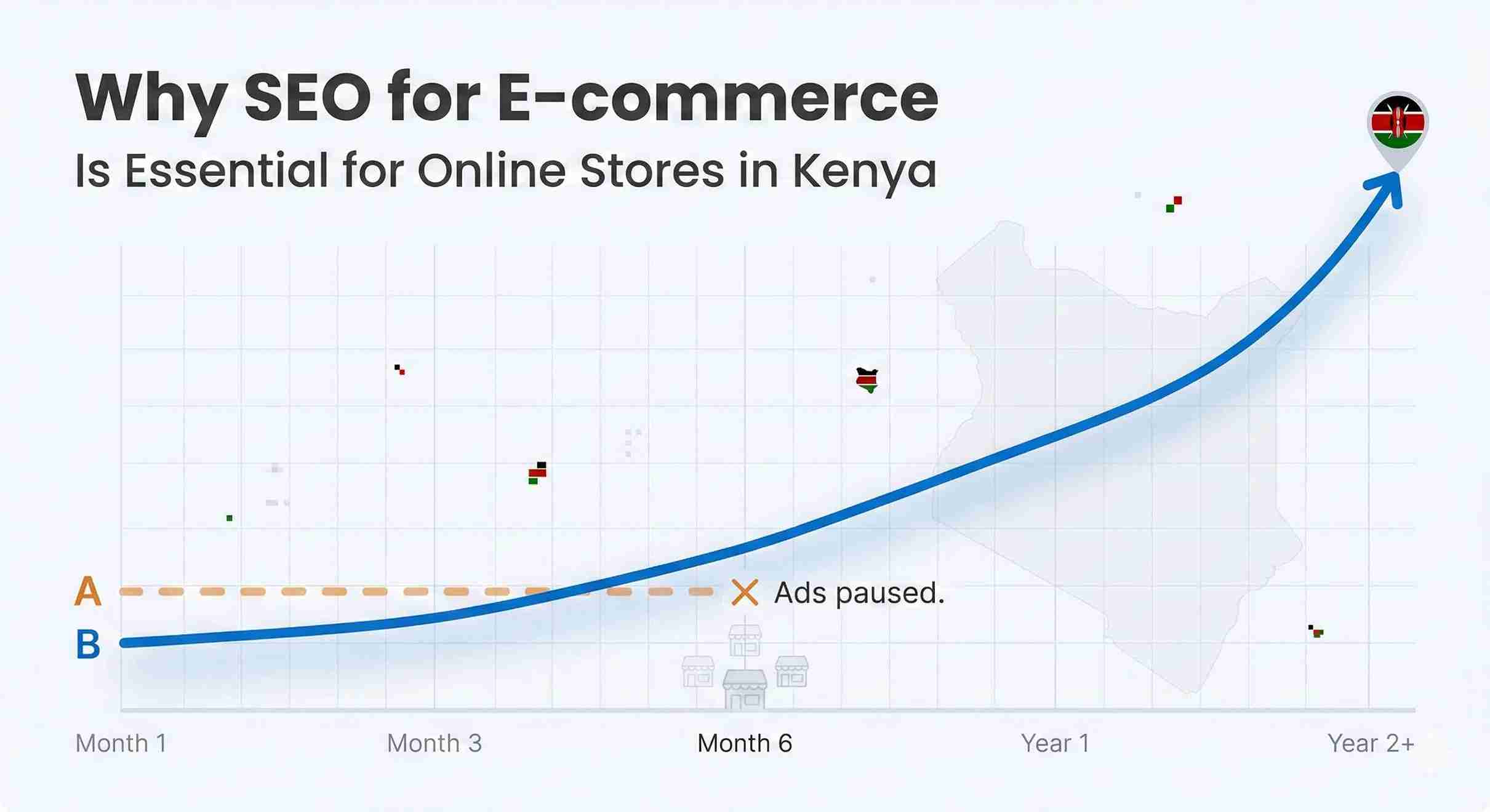
The businesses that win on Google in 2026 are not the ones with the biggest ad budgets. They are the ones built on platforms that allow them to:
- Optimize every technical element for Core Web Vitals.
- Publish comprehensive content that answers real buyer questions.
- Implement schema markup that generates rich snippets.
- Build genuine authority through EEAT signals.
Our previous article helped you choose a platform based on budget and business model. This guide shows you how to choose based on what actually drives SEO success in 2026.
Choosing the right platform decides whether you rent traffic or own it. Choosing the right team decides whether that traffic actually finds your store and converts. OnMedia is that team. We combine SEO strategy and web design to build WooCommerce stores that rank, attract real customers, and turn visits into sales.
The right team + the right platform = lasting search visibility, more qualified traffic, and measurable growth for your business.
Ready to take action? Book a free strategy call and let’s map out your SEO-optimized WooCommerce store that ranks, converts, and grows your brand.