

Kenya’s e-commerce market is projected to hit US $922 million in 2025 and grow to over US $1 billion by 2029, according to Statista. Yet the vast majority of Kenyan online stores remain invisible on Google.
When a shopper searches “buy leather shoes online Kenya,” they find Jumia, Kilimall, and a handful of international brands; not the hundreds of D2C stores that actually sell those products.
The problem is not that SEO doesn’t work for Kenyan e-commerce; it’s that most stores have never done it properly. They’ve focused on social media ads, influencer deals, and M-Pesa promotions. These work, but only for as long as you keep paying. The moment you stop, the traffic vanishes.
That’s why mastering SEO as an e-commerce business owner is so important. But how can you do that when every guide online is either aimed at international audiences with little relevance to Kenya, or claims to be local but lacks the depth and actionable steps needed to make a real difference?
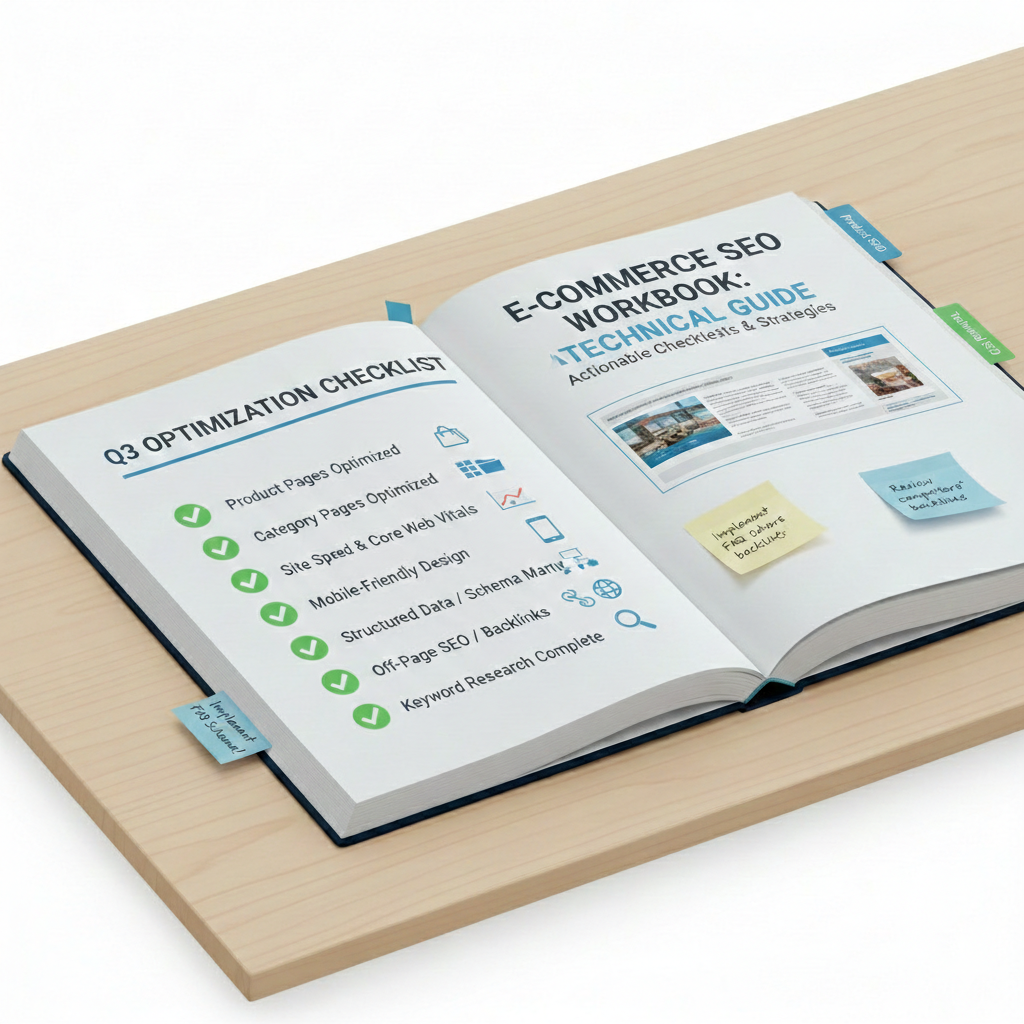
That’s exactly why this checklist exists. It’s built specifically for D2C e-commerce brands in Kenya and across Africa. Every point is actionable, prioritised by impact, and designed to get your product pages (not blog posts) ranking on Google’s first page.
Let’s break it down into six sections: Foundation, Technical SEO, Product Page Optimisation, Category Pages, Off-Page SEO, and Tracking. At the end, you’ll find a downloadable summary you can hand to your team or developer.
1. Foundation: Get Your House in Order First
Before touching a single product page, you need your technical foundation right. Google’s own ecommerce SEO documentation emphasises that sharing your site structure and product data correctly is the single most important thing you can do to be discoverable.
Here’s where to start:
Set Up Google Search Console and Google Analytics 4
This is non-negotiable. Google Search Console (GSC) is the only tool that tells you exactly how Google sees your site: what’s indexed, what’s not, and what errors exist. GA4, on the other hand, tells you what happens after someone lands on your site.
If you’re running an online store without both of these connected, you’re flying completely blind. So make sure you:
- Verify your site ownership in Google Search Console (both www and non-www versions)
- Set up GA4 with e-commerce tracking enabled (track purchases, add-to-carts, and product views)
- Submit your XML sitemap to GSC (yourdomain.co.ke/sitemap.xml)
- Link GA4 and GSC for combined reporting
Run a Baseline SEO Audit
You cannot improve what you don’t measure. Before making changes, document where you currently stand. Use a tool like Ahrefs, Semrush, or even the free version of Screaming Frog to crawl your site and identify issues.
Pay attention to how many of your pages are actually indexed. For most Kenyan stores we audit, it’s shockingly low.
Here’s an audit checklist to guide you:
- Check indexed pages: search “site:yourstore.co.ke” in Google to see what’s actually appearing
- Identify crawl errors in GSC (Coverage or Pages report)
- Document current keyword rankings for your top 20 products
- Run a competitor gap analysis: What keywords are Jumia and your top 2 competitors ranking for that you’re not?
Do Proper Keyword Research (the E-commerce Way)
This is where most Kenyan online stores go wrong. Many focus on broad, informational keywords like “skincare tips” or “best shoes,” which attract casual browsers instead of buyers. For e-commerce, understanding search intent is critical. It tells you why someone is searching and helps you assign the right keywords to the right pages.
People search differently depending on what stage they’re at in the buying journey. Take, for example, someone looking for a handmade leather wallet. The phrases they use will vary depending on whether they’re:
- Just learning about wallets
- Comparing options
- Ready to buy
Using this example, let’s break down each type of search intent, the keywords people actually use, and the pages where you should target them.
1. Informational intent
At this stage, people are learning or exploring. They’re not ready to buy yet, but they’re gathering information. Their search terms/phrases often include “how to,” “tips,” or educational questions. For example, someone interested in a handmade leather wallet might search:
- “How to choose a leather wallet.”
- “Benefits of handmade leather wallets”
How to target them: Create guides, blog posts, or educational content that answers their questions. Include links to relevant product pages so when they’re ready to buy, your store is top of mind.
2. Commercial intent
Once people start evaluating options, they enter the comparison stage. Their searches include words like “best,” “reviews,” or “compare.” For example, for a handmade leather wallet, someone might search:
- “Best handmade leather wallets Kenya.”
- “Handmade leather wallet reviews”
How to target them: Build category pages, comparison content, or curated product lists that highlight your top products. Make it easy for them to compare options and guide them toward your product pages.
3. Transactional intent
Finally, people with transactional intent are ready to buy. Their search terms/phrases include “buy,” “order,” or “delivery,” often with a location. For example, someone looking for a handmade leather wallet might type:
- “Buy handmade leather wallet Nairobi”
- “Order handmade leather wallet online Kenya”
How to target them: Optimise product pages to match these queries. Include clear product details, pricing, shipping info, and calls-to-action. These pages are designed to convert searches into purchases.
The golden rule:
Google recommends one keyword intent per URL. Don’t try to rank a product page for an informational query, and don’t waste a blog post on a transactional keyword. Each page should serve a single purpose and meet the needs of searchers at a specific stage in the buying journey.
Action checklist steps for your store:
- Research 20–30 transactional keywords for your top-selling products.
- Research 10–15 commercial keywords for your category pages.
- Map every keyword to a specific URL — one keyword per page.
- Include Kenya-specific modifiers like “in Kenya,” “Nairobi,” “delivery Kenya,” or “M-Pesa payment” to capture local search traffic.
2. Technical SEO: Make Google’s Job Easy
Technical SEO is the infrastructure that makes everything else possible. Google has an entire section of its e-commerce documentation dedicated to site structure, URL design, and crawlability. If Google can’t crawl and index your pages efficiently, nothing else matters.
Here’s what you need to focus on:
Site Speed and Core Web Vitals
Site speed is a direct ranking factor, and it affects your sales. A study commissioned by Google and conducted by Deloitte Digital and Fifty‑Five shows that improving mobile load time by just one-tenth of a second can increase conversion rates by 8.4% and average order value by 9.2 % in retail.
For Kenyan users who are predominantly on mobile with varying connection speeds, this matters even more.
Here’s your action checklist:
- Target page load time under 3 seconds (test at PageSpeed Insights)
- Compress all product images (use WebP format where possible)
- Enable browser caching and GZIP compression
- Minimise CSS and JavaScript files
- Use a Content Delivery Network (CDN) if you serve customers across multiple African countries
Mobile-First Optimisation
Over 80% of Kenyan internet users access the web through mobile devices. Plus, Google indexes the mobile version of your site first. So if your store looks great on desktop but is clunky on mobile, Google is judging you on the clunky version (and so are your customers).
To fix this,
- Test your site with Google’s Lighthouse or another mobile-friendliness testing tool of your choice.
- Mobile-Friendly Test tool
- Ensure tap targets (buttons, links) are at least 48px with adequate spacing
- Make sure text is readable without zooming (minimum 16px font)
- Verify the checkout flow works smoothly on mobile (especially M-Pesa integration steps)
Crawlability and Indexation
A website that Google can’t crawl is invisible. Google’s ecommerce documentation specifically highlights URL structure and sitemap management as critical for online stores because they typically have hundreds or thousands of product pages.
Action checklist:
- Generate and submit an XML sitemap that includes all product, category, and key content pages
- Check robots.txt to ensure you’re not accidentally blocking product or category pages
- Fix broken links and 404 errors (check GSC for these weekly)
- Implement HTTPS across your entire site (this is a ranking signal)
- Use clean, descriptive URLs: yourstore.co.ke/leather-shoes/brown-oxford NOT yourstore.co.ke/product?id=4827
- Handle faceted navigation properly. If your filters create duplicate URLs, use canonical tags or noindex
Site Architecture
Your store’s structure should be shallow and logical. Google recommends that every important page be reachable within 3 clicks from the homepage.
For e-commerce, this typically means: Homepage → Category → Product. Avoid burying products deep in subcategory after subcategory.
Action checklist:
- Aim for a flat site structure: Homepage > Category > Product (3 clicks maximum)
- Implement breadcrumb navigation on every product and category page
- Link related products to each other (internal linking is free and powerful)
- Make sure no product page is orphaned (every page should be linked from at least one other page)
3. Product Page Optimisation: Where the Money Is
This is where most e-commerce SEO guides get it wrong. They spend 80% of their time talking about blog content and 20% on product pages. We flip that ratio. Your product pages are the pages that actually generate revenue. They should be your number one optimisation priority.
Title Tags and Meta Descriptions
The title tag is the single most important on-page SEO element according to virtually every ranking study. For product pages, your title needs to include the product name, a key benefit or specification, and your brand. Keep it under 60 characters so Google doesn’t cut it off.
Formula: [Primary Keyword] – [Benefit/Spec] | [Brand Name]
Example: Brown Leather Oxford Shoes – Handmade in Kenya | Zuuri
Your action checklist:
- Write unique title tags for every product page (under 60 characters)
- Write compelling meta descriptions with a CTA (under 155 characters)
- Include your primary keyword naturally in the H1 tag
- Never duplicate title tags across products — even similar ones need unique titles
Product Descriptions That Rank and Sell
A huge percentage of Kenyan e-commerce stores use manufacturer descriptions. This results in the same copy appearing on dozens of Kenyan e-commerce sites.
If you’ve been doing this, it needs to stop. Google sees your product descriptions as duplicate content and has little reason to rank your versions over anyone else’s. You need original, detailed product descriptions of 300 words minimum that naturally incorporate your target keyword.
Your action checklist:
- Write original descriptions of 300+ words for every product (prioritise best-sellers first)
- Include the primary keyword within the first 100 words
- Cover features, benefits, materials, sizing, and use cases
- Add an FAQ section to each product page addressing common buyer questions
Product Images and Alt Text
Images sell products, and Google Images is a significant traffic source for e-commerce. But Google can’t “see” your images. It reads the alt text and file name to understand what’s in the picture.
Your action checklist:
- Use descriptive file names: brown-leather-oxford-shoe.webp NOT IMG_4829.jpg
- Write descriptive alt text for every product image (include the keyword naturally)
- Use multiple high-quality images per product (front, back, detail, in-use)
- Compress images to keep file sizes under 200KB without sacrificing quality
Structured Data (Schema Markup)
Structured data is code you add to your product pages that tells Google exactly what the page contains: price, availability, ratings, and brand. Google’s e-commerce documentation lists this as one of the top priorities for any online store. It’s what gets you those rich snippets with star ratings and prices directly in search results, which dramatically increases click-through rates.
Your action checklist:
- Implement Product schema on every product page (name, price, availability, image, description)
- Add Review/Rating schema if you have customer reviews
- Include Breadcrumb schema for better SERP display
- Validate your schema using Google’s Rich Results Test tool
- Consider adding FAQ schema to product pages for extra SERP real estate
4. Category Page Optimisation: Your Secret Weapon
Category pages are often the most underutilised asset on Kenyan e-commerce sites. They’re the pages that should rank for broader, high-volume keywords like “men’s shoes Kenya” or “organic skincare products.” Most stores treat them as simple product listing pages with no unique content. That’s a missed opportunity.
Your action checklist:
- Write unique, keyword-optimised introductory content for every category page (150-300 words)
- Create a unique title tag and meta description for each category
- Use the H1 tag for the category name with your target keyword
- Add internal links from category pages to your top product pages
- Implement proper filtering without creating duplicate URL issues
- Cross-link between related categories (“You might also like” sections)
5. Off-Page SEO: Building Authority
On-page optimisation gets you in the game. Off-page SEO, primarily backlinks, is what helps you win it. Backlinks from reputable websites tell Google that other sites trust yours. For Kenyan e-commerce brands, this is an area of massive untapped potential because most of your competitors aren’t doing it at all.
Your action checklist:
- Get listed on Kenyan business directories (Yellow Pages Kenya, KenyaBuzz, etc.)
- Pitch product features or founder stories to Kenyan media (Business Daily, TechCabal, etc.)
- Collaborate with Kenyan bloggers and influencers for product reviews with backlinks
- Monitor unlinked brand mentions and request the site owner to add a link
- Create a Google Business Profile if you have a physical location or showroom
- Encourage customer reviews on Google. They build trust and influence rankings
A critical note: never buy backlinks from shady link farms or directories that exist solely for SEO. Google’s algorithms are sophisticated at detecting unnatural link patterns, and the penalty can be as devastating as your entire site disappearing from search results.
6. Tracking and Measuring Results
SEO without measurement is guesswork. You need to track what’s working, what’s not, and where to double down. Here are the metrics that actually matter for e-commerce SEO:
Your action checklist:
- Track organic traffic weekly in GA4 (compare month-over-month)
- Monitor keyword rankings for your target terms (weekly)
- Track organic revenue and conversion rate in GA4 e-commerce reports
- Check GSC for indexation issues, crawl errors, and click-through rates
- Review top landing pages monthly — which product and category pages drive the most organic revenue?
- Set up GSC email alerts for critical issues (security, manual actions)
7. Kenya-Specific Considerations Most Guides Miss
This is where a generic checklist fails you. The Kenyan e-commerce market has unique characteristics that affect your SEO strategy. With WooCommerce powering over 75% of Kenya’s online stores and mobile being the dominant access point, your technical and content decisions need to reflect this reality.
Here’s a rundown of what you need to prioritize:
WooCommerce-Specific SEO
Since WooCommerce runs on WordPress, you have access to feature-rich SEO plugins. Use Yoast SEO or Rank Math to handle your title tags, meta descriptions, sitemaps, and schema markup. But don’t rely on default settings; you need to customise product and category page templates for proper optimisation.
M-Pesa and Payment Page SEO
Many Kenyan shoppers specifically search for stores that accept M-Pesa. Mentioning “M-Pesa accepted” or “pay with M-Pesa” on your product pages, footer, and checkout description not only improves the user experience, but also allows you exploit a keyword opportunity that most stores ignore.
Local Search and Delivery Areas
If you deliver to specific areas (Nairobi, Mombasa, Kisumu, etc), create content that includes these location terms. A page or section addressing “same-day delivery Nairobi” or “free delivery within Westlands” serves both your customers and Google’s local search algorithms.
Competing Against Jumia and Kilimall
You won’t outrank Jumia for “buy phone online Kenya.” But you can absolutely outrank them for long-tail, niche product queries. Focus on specificity: “handmade leather wallet Nairobi,” “organic shea butter Kenya,” “African print maxi dress plus size.” The more specific and descriptive, the better your chances against the marketplaces.
The Bottom Line: Product Pages First, Everything Else Second
Most e-commerce SEO advice tells you to start a blog. We disagree. Start with the pages that make you money. Optimise your product pages, then your category pages, then your technical foundation. Once those are solid, content marketing amplifies everything.
If you’re a Kenyan D2C brand spending 500K+ KES monthly on paid ads and wondering why you’re invisible on Google, the answer is in this checklist. Every single item here is something you can act on today.
The question is: do you have the time and expertise to execute all of it?
Want Us to Run This Checklist on Your Store?
OnMedia offers a free Visibility Audit for D2C e-commerce brands in Kenya. We’ll show you exactly where you stand on Google, what keywords you’re missing, and how much revenue you’re leaving on the table.
It takes 48 hours. It’s free. No strings attached.
Book a Free Strategy Call to get started.


