If you are paying an SEO agency every month, what exactly are you paying them to do?
For most business leaders, the answer probably sounds familiar. You want them to improve your rankings, publish content, fix whatever is wrong with the website, build authority and hopefully get more people coming through Google.
At the end of the month, you receive a report showing the work that was done, the keywords that moved up or down and whether organic traffic increased.
There is nothing inherently wrong with any of that. Rankings, technical SEO, content and links matter. The problem is that we have spent years reducing SEO to these individual activities, to the point where they have almost become the definition of the work itself.
I think that definition is becoming too narrow for what modern SEO should look like.
The question a founder or business leader should increasingly be asking is not simply, “Where do we rank?” It is: “When someone is looking for what we sell, how likely are they to discover us, understand why we are relevant and eventually consider doing business with us?”
That sounds like a small difference, but it changes the conversation around SEO completely.
Ranking #1 on Google made sense when the journey was simpler
For a long time, the model was fairly straightforward. Someone had a need, they went to Google, typed in a keyword, looked through the results and clicked one of the websites near the top.
If your website ranked in position one, two or three, you were in a great place. More visibility generally meant more clicks, and more relevant clicks could mean more enquiries, purchases or bookings. Naturally, rankings became one of the clearest ways to judge whether SEO was working.
That is still true to an extent. If you sell something people actively search for and your competitors consistently appear above you, that matters and it’s a game you want to win.
What has changed is everything happening around that organic result.
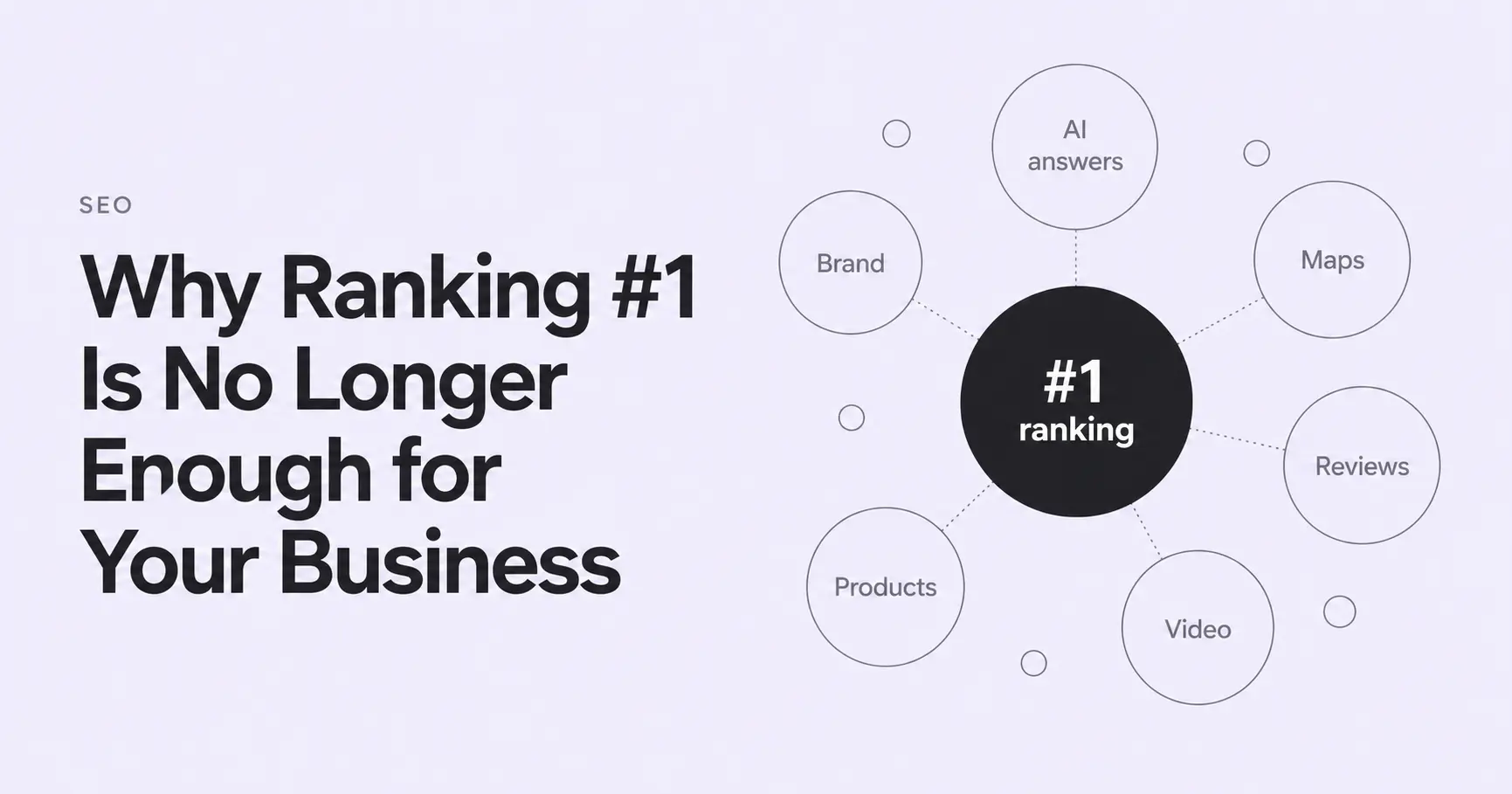
Depending on the query, someone searching today might see paid ads, a map pack, images, videos, products, an AI Overview and several other search features before or alongside the traditional organic listings.
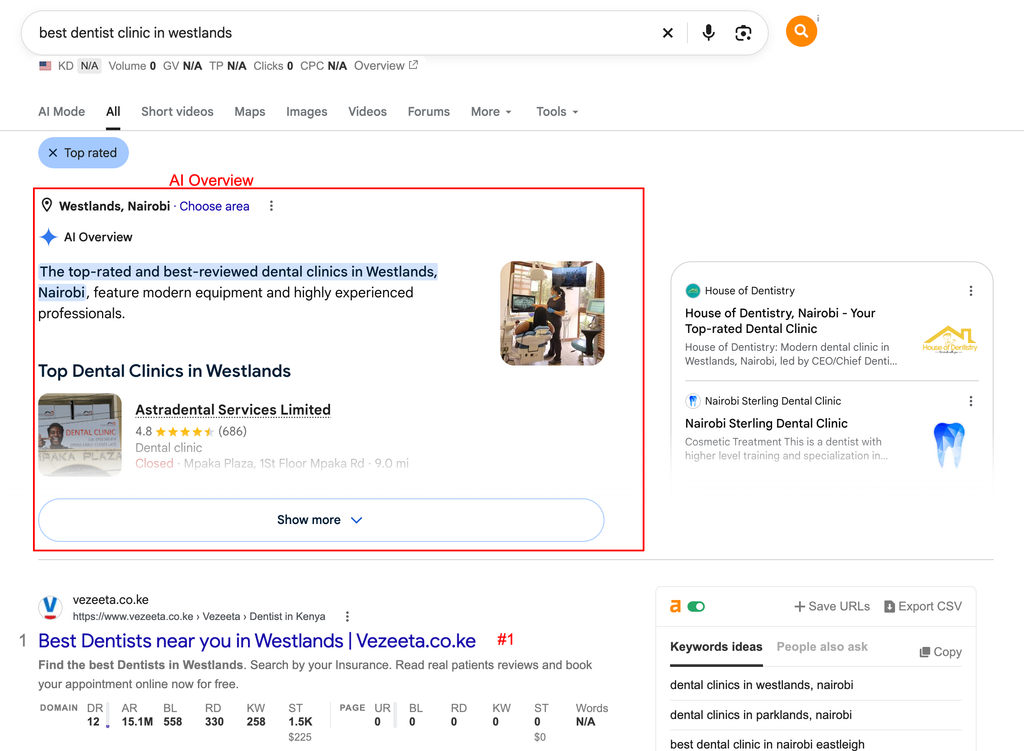
Even when your website technically holds the number-one organic position, it does not necessarily occupy the same amount of attention it once did.
There is already data showing the impact. Ahrefs analysed 300,000 keywords using Search Console data and found that, for the informational queries it studied, the presence of an AI Overview correlated with a 58% lower average click-through rate for the page ranking in position one compared with its estimated no-AI-Overview baseline.
That does not mean every number-one ranking suddenly loses 58% of its traffic, but it does illustrate why ranking position alone is becoming a weaker description of actual search visibility.
And Google itself is only one part of what is changing.
Someone can now open ChatGPT, Claude, Gemini or another AI product and ask for recommendations instead of searching through a list of websites themselves. They can describe what they need in much more detail, ask follow-up questions, compare options and narrow down their decision without ever using the kind of keyword we would traditionally track in an SEO report.
The need is still there. The discovery journey has simply become much broader.
Consider a dental clinic in Nairobi
Imagine a dental clinic that has been operating in Nairobi for 20 years.
The managing dentist has been practising for more than 30 years. The clinic has several other dentists, modern diagnostic equipment and extensive experience across implants, orthodontics, restorative dentistry, paediatric dentistry and general dental care.
They have treated thousands of patients, invested in training over the years and built the kind of reputation that leads existing patients to refer their friends and families.
Maybe they have successfully handled particularly difficult implant cases. Perhaps one dentist has advanced orthodontic training. The clinic has relationships with several insurers, and its team has learnt a lot over the years about dealing with patients who are anxious about dental treatment.
There is a good business there.
Now open the website.
The homepage tells you that they are a “leading dental clinic in Nairobi committed to providing quality and affordable dental care.” Somewhere further down the page there is a list saying they provide braces, implants, whitening, root canals and general dentistry.
That is almost the entire website.
There are no dedicated pages providing useful information about each treatment. Dental implants are mentioned in a list, but there is nowhere explaining who they are suitable for, how the clinic approaches them, what patients should expect, who performs the procedures or what experience the team has.
The managing dentist has three decades of experience, but the website gives him a photograph, his name and perhaps the word “Director.”
There is no substantial page about the doctors. There are no useful case examples. Patient questions being answered every day inside the clinic have never been documented online. Their insurance information is difficult to find. Their Google reviews contain years of valuable feedback, but very little of what patients consistently appreciate about the clinic is reflected on the website.
Now compare that with a newer clinic whose digital presence clearly explains its treatments, introduces its practitioners properly, documents their qualifications, answers common patient questions and has useful information across its website, Google Business Profile, industry listings and other relevant places online.
The first clinic may genuinely have more experience.
But from the perspective of someone trying to research both businesses online, much of that advantage is invisible.
And that is not merely a keyword problem.
Search cannot work with information that has never been made visible
Google does not attend your management meetings. It does not know that your managing director has spent 30 years practising dentistry simply because everyone inside the company knows it.
It does not automatically know that you installed new equipment last quarter, that your team completed specialist training, that you recently handled a difficult project particularly well or that customers constantly praise a particular part of your service.
Those things have to become information.
This is one of the most useful ways I have come to think about modern SEO: as a translation layer between what a business actually is and what people and search systems can understand about that business online.
See… businesses accumulate experience, accomplishments, relationships, expertise and customer feedback in their day-to-day operations, but much of it never becomes discoverable outside the company.
For our dental clinic, the raw material already exists. Thirty years of experience exists. The procedures exist. The qualifications exist. The patient questions exist. The successful outcomes exist.
SEO should help determine which parts of that information are useful to prospective patients and how they should be presented so that they can actually be found and understood.
Sometimes that means building proper service pages. Sometimes it means better practitioner profiles, FAQs, local optimisation, case-led content, review management, structured information or earning legitimate references elsewhere online.
The point is not to manufacture reasons why the clinic is good. The business has to create those reasons in the first place and SEO helps prevent them from remaining invisible.
AI makes this problem more important, not less
This becomes particularly interesting when we add AI search (GEO/AEO) into the equation.
A potential patient no longer needs to search for something as simple as “dentist Nairobi.” They can have a much richer conversation with an AI platform.
They might ask:
“Which dental clinics in Nairobi have experienced implant dentists and strong patient reviews?”
Someone else could ask:
“I’m very nervous about dental treatment. Which clinics in Nairobi seem particularly good with anxious patients?”
Another person might ask for clinics offering a specific orthodontic treatment, accepting a particular insurer or operating in a certain part of Nairobi.
For an AI system to reference a business meaningfully, there needs to be information it can work with. Depending on the product, that can involve a combination of model knowledge, web retrieval and information available from the business itself and third-party sources.
For Google’s own AI experiences, the link to traditional search is particularly clear. Google says AI Overviews and AI Mode use its existing Search systems and can retrieve supporting web content, while the same fundamental SEO practices still apply. There is no completely separate technical trick that allows a business to ignore the basic work required to make its information accessible and useful.
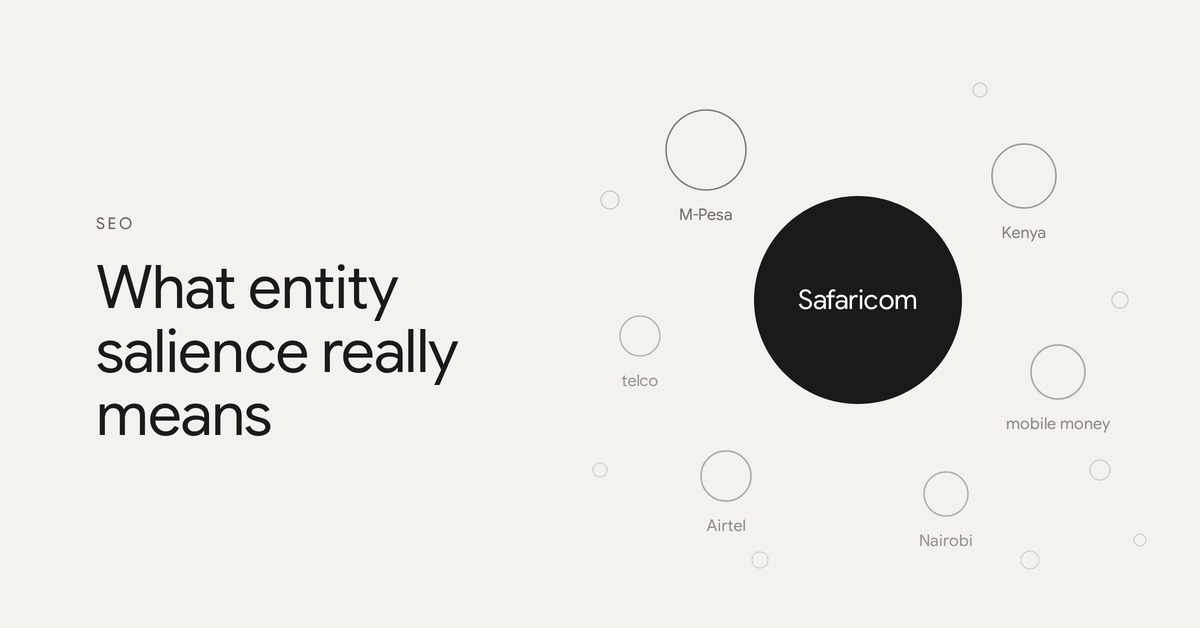
That means the factual footprint around your business becomes incredibly important.
- What does your website actually say about you?
- What do customer reviews reveal?
- Are your people and their expertise clearly represented?
- Are your services explained properly?
- Is information about the company consistent elsewhere on the web?
- Are reputable third parties talking about you, and can important claims about the business be independently verified?
This is why I struggle with the idea that AI visibility is simply another deliverable to add to an SEO package.
It is bigger than that.
SEO needs to move closer to brand visibility
A lot of SEO has historically been packaged around things that are easy to count.
- Four blog posts.
- Ten backlinks.
- Twenty optimised pages.
- Fifty keywords being tracked.
There is comfort in that because everybody can see what was delivered. But a business can receive all of those deliverables and still have the more fundamental problem we saw with our dental clinic: there simply is not enough useful information online explaining why this particular business should be considered.
Publishing another generic article titled “5 Benefits of Visiting Your Dentist Regularly” does not solve that.
Neither does creating an 800-word page repeating the words “best dentist in Nairobi” several times.
The business might get much more value from properly documenting its dentists, creating substantial pages around commercially important services, improving its local presence, surfacing meaningful patient feedback and making its real expertise more visible.
In some cases, the most useful SEO work might not look like what a founder has traditionally been taught to expect from SEO at all.
That is where SEO starts becoming part of a broader brand visibility function.
That also changes the relationship between SEO and the business
If this is how we think about search, SEO cannot operate completely disconnected from what is happening inside the company.
The search team needs to understand the business.
For a dental facility, they should know when a new dentist joins the team, when new equipment is acquired, when the clinic introduces a treatment, when doctors complete relevant training, which questions patients repeatedly ask and what concerns prevent prospective patients from booking.
They should understand what patients appreciate about the clinic and what the business genuinely does better than the alternatives.
The same applies outside healthcare.
If you run an interior design company, your SEO agency should know about the major project you just completed.
If you run a trusted tour company in Kenya, they should understand the destinations your guides know particularly well, the unusual trips you have successfully organised and the questions travellers repeatedly ask before booking.
If you sell software, they need to understand the use cases customers love, the integrations you have launched and why users switch to you from another platform.
These are not simply “SEO updates.” They are business information that can become part of how the market understands the brand.
When that flow of information does not exist, even a capable SEO team is forced to work with an incomplete picture of the company it is supposed to represent.
So what should a business leader measure?
None of this means you should stop looking at rankings.
Rankings remain useful diagnostics. So do impressions, clicks, organic sessions, backlinks and all the other metrics we have traditionally used.
But they should sit inside a bigger conversation.
A business leader should want to understand whether the company is gaining visibility around commercially valuable problems, whether the right audiences are discovering it and whether that visibility is contributing to enquiries, bookings, purchases or other meaningful outcomes.
For a local business, prominence and relevance also matter. Google explicitly says its local results are mainly influenced by relevance, distance and prominence, with information such as links and reviews contributing to how prominence is understood.
We should also be asking whether the information online accurately represents the business.
- Are the services clearly understood?
- Are our people and expertise visible?
- Are customers increasingly searching specifically for the brand?
- Are we being mentioned in places that matter within our market?
- Do we appear when relevant questions are asked across AI platforms?
That is a much richer view of search performance than celebrating because one keyword finally moved from position two to position one.
Ranking #1 is still good. It is simply not the whole job anymore
The customer never actually wanted to click the number-one result.
They wanted something else.
They had a painful tooth and wanted a dentist they could trust. They wanted to buy land without being conned. They wanted to plan a safari, find a medical test, choose software, hire an accountant or solve whatever problem had brought them to search in the first place.
For years, ranking at the top of Google was one of the clearest ways for a business to put itself in the middle of that moment.
It still is one of them.
But search is now happening across traditional results, Maps, AI Overviews, conversational AI platforms, videos, images, third-party websites and other touchpoints. The path between having a need and eventually choosing a business is becoming less linear.
That means the ambition has to become bigger than owning position one.
The real goal is to make sure your business is present when demand is forming, and that when someone encounters your brand, there is enough useful information for them to understand why they should consider you.
Technical SEO helps make that information accessible. Content helps explain it. Links, mentions, reviews and other third-party signals help extend and validate it. AI introduces another environment in which that information can be discovered and synthesised.
The individual SEO activities still matter. What needs to change is the way we think about what all of those activities are ultimately trying to achieve.
Your business has to create something worth finding and modern SEO should make sure it can actually be found.
OnMedia SEO team can help
If your website has been live for months or years, but it still isn’t bringing in the kind of visibility, enquiries or revenue you expected, the answer may not simply be “more content” or “more backlinks.”
Sometimes the bigger issue is that your website and wider digital presence don’t clearly reflect what makes your business valuable in the first place.
At OnMedia, that is the kind of work we focus on: understanding the business, identifying where the search and AI visibility gaps are, and building a strategy around what actually needs to change.
That could mean technical SEO, better service pages, stronger local visibility, clearer brand information, content, authority building, AI search optimization or a combination of all of them.
The point is not to do SEO activity for the sake of activity. It is to make sure your business is easier to discover when the right customer is looking.