

You do not need another article telling you that Shopify is “easy” and WooCommerce is “flexible.”
You already know that.
What you need is a straight answer to the question every serious business owner eventually asks:
Where should I actually build my online store if I want sales, control, and room to grow?
Because choosing among the many e-commerce platforms in Kenya is not really a tech decision.
It is a business model decision.
Pick the wrong platform, and it quietly taxes everything. Your margins. Your customer data. Your search visibility. Your ability to run offers. Your checkout experience. Your sanity when orders start coming in faster than your current system can handle.
Pick the right one and the platform disappears into the background. Customers find you. They trust you. They pay without drama. You fulfil the order. You follow up. You sell again.
That is the point.
Your e-commerce platform should not become the business. It should help the business move.
This guide breaks down the best e-commerce platforms for Kenyan businesses from a founder’s point of view. Not what looks good in a comparison table. Not what sounds impressive in a pitch. What actually makes sense depends on your budget, margins, products, payment needs, technical comfort, and growth plans.
Let’s make the decision simpler.
The Short Answer
There is no single best e-commerce platform in Kenya.
There is only the best platform for the stage your business is in right now.
| Business situation | Best fit | Why |
|---|---|---|
| You are validating demand and mostly sell through DMs | Instagram, Facebook, TikTok, and WhatsApp | Fast, familiar, low cost, good for testing offers |
| You want a proper online store without technical headaches | Shopify | Easy to launch and manage, but monthly costs and payment setup matter |
| You want ownership, SEO, content, and long-term control | WooCommerce | Strong for search, flexible, and better value when built properly |
| You want marketplace traffic immediately | Jumia | Useful for reach, but you give up margin, control, and customer ownership |
| You have complex operations and a serious volume | Custom ecommerce website | Built around your business, but expensive and usually overkill early on |
If you want the founder shortcut, here it is:
Use social commerce to test demand. Use Jumia to test marketplace appetite. Use Shopify if speed matters more than control. Use WooCommerce if you want to build an e-commerce asset you own. Go custom-only when your operations have outgrown standard platforms.
Now let’s unpack that properly.
What Kenyan Business Owners Get Wrong About E-commerce Platforms
Most founders compare e-commerce platforms backwards.
They start with features.
- Does it have templates?
- Does it support M-Pesa?
- Can I add products easily?
- Does it look modern?
- Can customers pay by card?
Those questions matter, but they come too late.
The better starting point is this:
How does this platform help my business make money without creating a bigger problem later?
A beautiful store that nobody finds is a decoration.
A Jumia listing that sells but leaves you with thin margins is not growth. It is an activity.
An Instagram page with hundreds of DMs but no order system is not a sales machine. It is a full-time admin job wearing nice product photos.
A custom website built too early can become a very expensive monument to impatience.
Before choosing a platform, ask five questions.
5 Questions to Ask Before Choosing an E-commerce Platform in Kenya
1. How do customers discover products like yours?
If people search on Google before buying, you need a platform that supports SEO properly.
If your products are impulse-driven, visual, and trend-based, social platforms may matter more at the start.
If customers already go to marketplaces to compare prices, Jumia may help you reach them faster.
A furniture business, a skincare brand, a laptop accessories shop, and a corporate gifting company should not all choose the same e-commerce setup.
Different products have different buying journeys.
2. How much margin can you afford to give away?
This is where many founders get caught.
A platform can look cheap because there is no setup cost, then become expensive because it takes a percentage of every sale.
Another platform can look expensive because you pay upfront, then it becomes cheaper over time because you own the store and keep more of the margin.
If your margins are thin, commission-based platforms can hurt quickly.
If your margins are healthy and you need reach now, a marketplace can still make sense.
3. Do you need to own the customer relationship?
This is not a small detail.
If you sell through your own website, you can build an email list, track repeat buyers, improve product pages, run remarketing, build search visibility, and understand what customers actually do before they buy.
If you sell only through a marketplace or social DMs, much of that relationship sits outside your business.
That may be fine while testing.
It becomes a problem when you want predictable growth.
4. How important is M-Pesa to your checkout?
In Kenya, payment experience is not a side feature.
It is conversion.
If checkout feels foreign, slow, or confusing, people abandon carts. If the customer has to message you, wait for a till number, send a screenshot, and then wait for confirmation, you will lose sales you never see.
For many Kenyan e-commerce businesses, M-Pesa support is not optional. It is table stakes.
5. Are you building for this month or the next three years?
The best platform for launching fast is not always the best platform for compounding growth.
This is why founders get conflicting advice.
A designer might recommend Shopify because it is clean and quick.
A developer might recommend WooCommerce because it is flexible.
A marketplace consultant might recommend Jumia because it already has traffic.
A social media manager might recommend Instagram because that is where your audience is active.
They may all be right inside their own lens.
Your job is to choose through the lens of the business.
The Best E-Commerce Platforms in Kenya Compared
Below is the real-world breakdown.
Not the polished version.
The version a founder needs before spending money.
1. Shopify

Best for: founders who want to launch quickly and do not want to manage technical details
Shopify is one of the easiest ways to build a professional online store.
You choose a theme, add your products, connect payment options, set up shipping, and start selling. Hosting, security, updates, checkout, product management, and order processing are handled inside the platform.
That is the appeal.
For a founder who wants an online store live quickly, Shopify is attractive because it removes many of the decisions that slow people down.
You do not need to think about hosting. You do not need to install WordPress. You do not need to worry about plugin conflicts. You do not need to call a developer every time you want to change a product image.
That convenience has a cost.
Shopify runs on monthly subscriptions. You may also pay extra for apps, themes, payment gateways, and third-party transaction fees. For Kenyan merchants, this matters because Shopify Payments is not currently available in Kenya, so you should expect to use third-party providers for payments.
That does not make Shopify bad.
It just means the real cost is not the price on the pricing page.
The real cost is the subscription plus gateway fees plus transaction fees plus any apps you need to make the store work the way Kenyan customers expect.
Shopify works well if:
- You want to launch fast.
- You are not technical.
- Your products have healthy margins.
- You are comfortable paying monthly for convenience.
- You do not need deep control over every part of the store.
- You want a clean backend your team can learn quickly.
Shopify may frustrate you if:
- Your margins are already tight.
- You want native M-Pesa simplicity without extra setup.
- You need heavy customization.
- You dislike monthly software costs.
- You want full ownership over your website stack.
- You are building a content-heavy SEO strategy around your store.
Founder’s verdict on Shopify
Shopify is a good platform when speed matters more than control.
It is especially useful for fashion, beauty, accessories, home decor, packaged goods, and other products where a clean store and smooth checkout can quickly turn traffic into orders.
Just do the maths before committing.
If your store makes KES 80,000 per month and platform costs take a painful chunk of that, Shopify may feel heavier than expected.
If your store makes KES 800,000 per month and your margins are healthy, the convenience may be worth it.
2. WooCommerce
Best for: founders who want control, search visibility, and long-term value
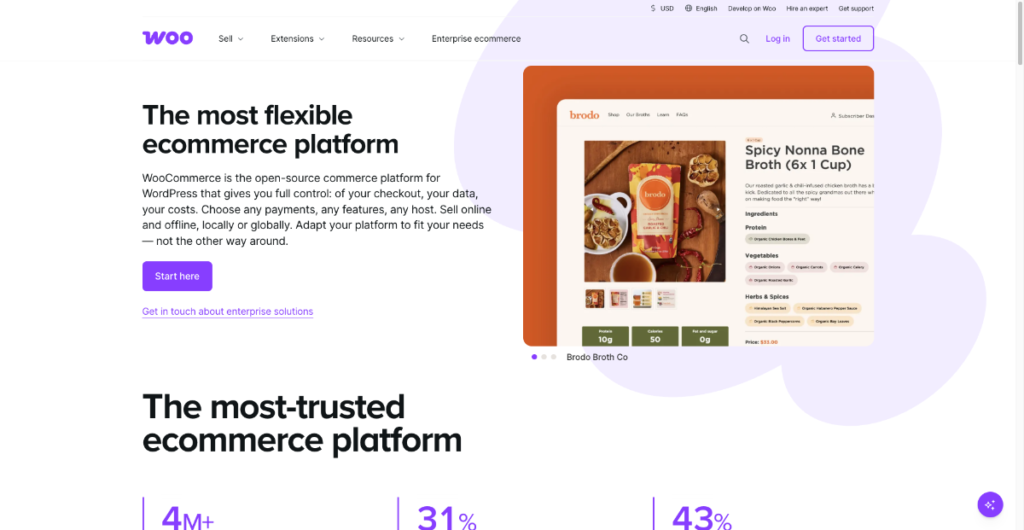
WooCommerce is a free, open-source e-commerce platform built on WordPress.
That sentence sounds simple, but the business implication is big:
With WooCommerce, you can own the platform instead of renting your entire e-commerce setup.
You still pay for hosting, domain, design, development, maintenance, payment processing, and any premium plugins you choose. So it is not “free” in the way some people imagine.
But WooCommerce gives you control.
You can structure product pages for SEO. You can publish buying guides. You can build category pages that rank. You can customize checkout. You can connect M-Pesa through supported payment providers. You can improve speed. You can create landing pages. You can keep your customer data. You can build an online store that becomes a search asset over time.
That is why WooCommerce is often the better long-term choice for Kenyan businesses that care about being found on Google and AI search, not just having a checkout page.
But there is a catch.
WooCommerce is only as good as the person setting it up.
A poorly built WooCommerce site can be slow, messy, insecure, and painful to manage.
A properly built WooCommerce store can become one of the strongest sales assets in the business.
WooCommerce works well if:
- You want your own e-commerce website.
- You care about SEO and organic traffic.
- You want control over content, product pages, and customer journeys.
- You want flexibility without paying a platform fee on every sale.
- You are willing to hire the right partner or learn the basics properly.
- You want to build something that compounds over time.
WooCommerce may frustrate you if:
- You want to launch tonight.
- You do not want to think about hosting, updates, backups, or maintenance.
- You do not have technical support.
- You install too many cheap plugins without a clear plan.
- You treat it like a DIY experiment when it should be a business system.
Founder verdict on WooCommerce
WooCommerce is the strongest choice for many serious Kenyan businesses because it gives you control where control actually matters.
Not just overdesign.
Over search visibility. Content. Data. Checkout. Product education. Landing pages. Analytics. Ownership.
If you are building a business that should still be selling online three years from now, WooCommerce deserves serious consideration.
Especially if Google search matters in your category.
3. Jumia Seller Account
Best for: businesses that want marketplace traffic and can afford the margin trade-off
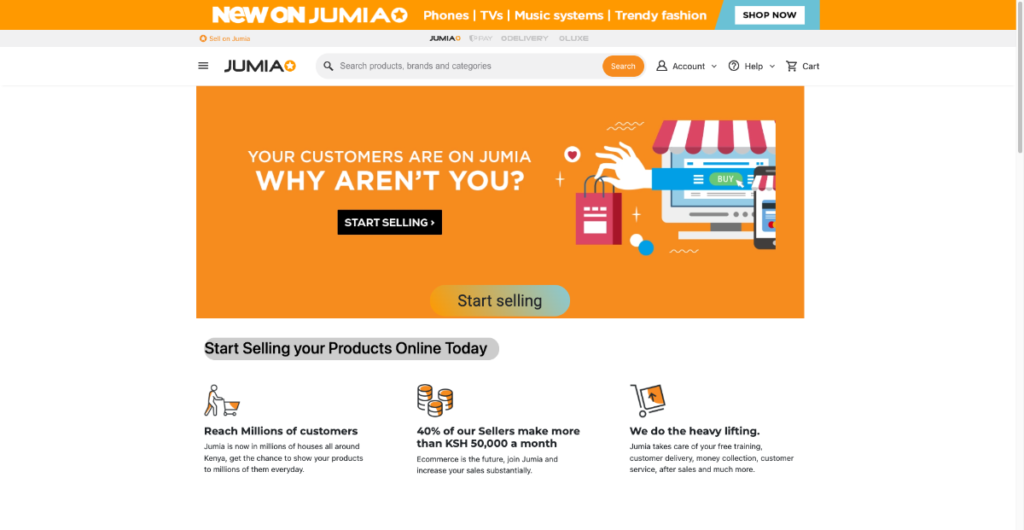
Jumia is not the same kind of platform as Shopify or WooCommerce.
With Shopify and WooCommerce, you build your own store.
With Jumia, you sell inside someone else’s marketplace.
That difference changes everything.
Jumia can give you access to buyers who are already browsing. That is powerful. You do not need to build a website, run SEO, set up hosting, or convince people that the checkout is legitimate. Customers already know Jumia.
For some businesses, that reach is worth paying for.
But marketplace reach comes with trade-offs.
You compete beside other sellers. Customers compare you on price. You have limited control over how your brand is experienced. Commission and related costs affect your margin. You also do not fully own the customer relationship in the same way you would on your own e-commerce site.
That does not make Jumia a bad idea. It makes it a specific idea.
Use it when the numbers make sense.
Jumia works well if:
- Your products fit active marketplace categories.
- Your margins can absorb commissions and related selling costs.
- You want reach without building traffic from scratch.
- You can compete on pricing, availability, reviews, and fulfilment.
- You see Jumia as one sales channel, not your whole ecommerce strategy.
Jumia may frustrate you if:
- Your margins are thin.
- Your brand experience matters deeply.
- You want customer data and repeat purchase systems.
- You sell products that require education before purchase.
- You do not want to compete mainly on price.
- You want to build long-term search visibility for your own brand.
Founder’s verdict on Jumia
Jumia can be useful as a demand channel. But it should not automatically become your entire ecommerce strategy.
If Jumia helps you move inventory profitably, use it. If it trains customers to buy from you only when you are discounted beside ten competitors, be careful.
The smartest play for many businesses is to treat Jumia as a sales channel while building their own owned store in parallel.
That way, you get marketplace reach without giving up the future of the brand.
4. Instagram, Facebook, TikTok, and WhatsApp
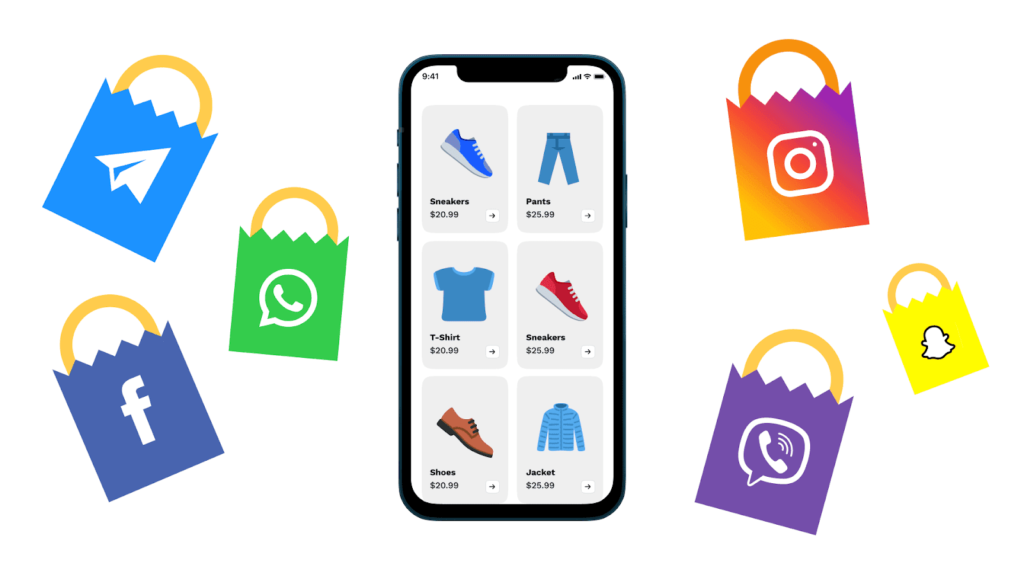
Image Source: Omnico
Best for: founders testing demand, building community, and selling visual products
Social commerce is where many Kenyan e-commerce businesses really begin.
Not with a website. With a post. A reel. A WhatsApp status. A TikTok video. A customer DM. A product photo. A payment confirmation. A rider pickup.
It is scrappy, but it works.
For fashion, beauty, food, accessories, gifts, home items, and lifestyle products, social platforms can create demand faster than a new website can.
People see the product. They ask for the price. They request delivery. They pay through M-Pesa. The business learns what sells.
That feedback loop is valuable.
But social selling becomes painful when order volume grows.
DMs get lost. Stock updates become manual. Customers ask the same questions repeatedly. Payment confirmation takes time. Delivery details sit inside chats. You cannot easily recover abandoned carts. You cannot properly track conversion. You cannot build strong search visibility from a WhatsApp thread.
Social commerce is a brilliant starting point.
It is a weak operating system for a growing e-commerce business.
Social commerce works well if:
- You are still testing products.
- Your products are visual and impulse-friendly.
- You have a small catalogue.
- You are founder-led and close to the customer.
- You want fast feedback before investing in a full store.
- You already have an audience on Instagram, TikTok, Facebook, or WhatsApp.
Social commerce may frustrate you if:
- You receive more orders than you can manually manage.
- You need proper inventory tracking.
- You want customers to check out without chatting first.
- You want SEO traffic.
- You need customer accounts, order history, abandoned cart recovery, or analytics.
- You want your brand to feel established and trusted.
Founder’s verdict on social commerce
Use social platforms to create demand but do not depend on them forever to manage demand.
A smart e-commerce setup in Kenya often looks like this:
- Social platforms create attention.
- Your website converts that attention.
- Email, WhatsApp, and search bring customers back.
- Your operations keep the promise.
That is a stronger system than trying to run the entire business from DMs.
5. Custom E-commerce Website
Best for: established businesses with complex needs and enough revenue to justify the investment
A custom e-commerce website sounds attractive because it promises freedom.
No platform limits. No template restrictions. No awkward plugin compromises. No marketplace rules. No monthly software dependency.
In theory, you can build exactly what your business needs.
In practice, custom e-commerce is expensive, slower, and more demanding than most founders expect.
You need developers. You need clear documentation. You need testing. You need maintenance. You need security. You need updates. You need someone responsible when checkout breaks on a Saturday night.
Custom is not wrong.
Custom is just not where most businesses should start.
It makes sense when your operations are genuinely unusual.
For example, you may need complex inventory rules, subscriptions, wholesale pricing, multi-branch fulfilment, custom delivery logic, ERP integration, advanced reporting, or a checkout experience no standard platform can support.
If that is you, custom can be worth it.
If all you need is products, cart, checkout, M-Pesa, delivery zones, and SEO, custom is probably too much too soon.
Custom ecommerce works well if:
- You are already doing serious online revenue.
- Your operations are too complex for normal platforms.
- You have a budget for building and ongoing maintenance.
- You have internal systems that need deep integration.
- You know exactly what you need because you have already outgrown simpler tools.
Custom ecommerce may frustrate you if:
- You are still validating demand.
- You have a limited budget.
- You need to launch quickly.
- You do not have a reliable technical partner.
- You are trying to build custom features before proving customers want the products.
Founder’s verdict on custom e-commerce
Custom is for businesses with custom problems.
Most founders do not need custom e-commerce.
They need a clear offer, a trustworthy website, smooth payments, strong product pages, search visibility, and a system that can handle orders without chaos.
Build custom when the business has earned that complexity. Not before.
Shopify vs WooCommerce in Kenya
This is the comparison most founders search for.
The honest answer is simple:
Shopify is easier. WooCommerce gives you more control.
That is the trade-off.
Shopify is better when you want speed, simplicity, and a managed ecommerce backend.
WooCommerce is better when you want ownership, SEO flexibility, content depth, and the ability to shape your store around your business over time.
| Question | Shopify | WooCommerce |
|---|---|---|
| Which is easier to launch? | Shopify | WooCommerce needs setup |
| Which gives more control? | Limited compared to open-source | Strong control over site, content, and data |
| Which is better for SEO? | Good enough for many stores | Stronger when built well |
| Which has lower upfront cost? | Usually Shopify | WooCommerce depends on build cost |
| Which has lower long-term platform fees? | Depends on plan, apps, and fees | Often lower if maintained well |
| Which is better for non-technical founders? | Shopify | WooCommerce if built and managed by a partner |
| Which is better for long-term ownership? | WooCommerce | WooCommerce |
If you are trying to launch this week and you do not want to involve a developer, Shopify is probably the easier choice.
If you are building a search-led ecommerce business and want your site to become a long-term growth channel, WooCommerce is usually the stronger foundation.
Jumia vs Your Own E-commerce Website
Jumia gives you access to buyers. Your own website gives you ownership.
Both can be useful, but they do different jobs.
Selling on Jumia is like renting shelf space in a busy supermarket. People are already walking through the aisles, but your product sits beside competitors, and the store controls the environment.
Selling on your own website is like building your own shop. You have to bring people there, but once they arrive, the experience is yours.
The mistake is thinking you must choose one forever.
Many businesses can use both.
Use Jumia to test marketplace demand, move selected products, and reach customers already browsing there.
Use your own website to build the brand, capture search traffic, own customer data, publish helpful content, and grow repeat sales.
One gives reach.
The other gives control.
A serious e-commerce business eventually needs both thinking muscles.
What About Local Ecommerce Website Builders in Kenya?
You will find many Kenyan agencies, freelancers, and website builders promising e-commerce websites.
Some are excellent.
Some will install a theme, add your logo, connect a payment plugin, and call it a strategy.
The platform matters, but the thinking behind it matters more.
A good e-commerce build should answer questions like:
- What products should be easiest to find?
- Which categories should rank on Google?
- How should customers move from product discovery to checkout?
- Where does M-Pesa fit in the buying journey?
- What happens after purchase?
- How will the store support repeat sales?
- What pages need to exist for search?
- What should the site track from day one?
- How will AI search and Google understand the business?
If a website partner only talks about design, be careful.
Design matters. But design without search, structure, conversion, speed, and measurement is just a prettier place for customers to get lost.
The Founder’s Decision Framework
Here is the simplest way to decide.
Choose social commerce if you are still proving demand
You do not need a full e-commerce website to test whether people want your products.
Start where the buyers already spend time. Post. Sell. Listen. Learn. Watch what people ask before buying.
But once orders become repetitive, move the buying process into a proper system.
Choose Shopify if you want the fastest professional store
Shopify is a strong option when you want speed and simplicity.
It is especially helpful if you have a clear product catalogue, decent margins, and a team that needs an easy backend.
Just budget for more than the subscription.
Choose WooCommerce if you want to own your e-commerce growth
WooCommerce is the best fit when your e-commerce website needs to become a long-term asset.
It is especially strong for businesses that care about SEO, content, product education, and customer data.
You need the right setup, but the upside is real.
Choose Jumia if the marketplace reach is worth the margin trade-off
Jumia can work if you know your numbers.
Do not sell there because it feels easy.
Sell there because the commission, fulfilment, pricing, and competition still leave you with a profitable channel.
Choose custom if normal platforms are limiting the business
Do not choose custom because it sounds serious.
Choose custom because your business has outgrown what standard platforms can do.
That is the right time.
The Best Ecommerce Platform in Kenya Is the One That Fits Your Growth System
Here is the part most articles miss.
Your e-commerce platform is only one part of the machine.
A profitable e-commerce business needs more than product pages and a checkout button.
- It needs search visibility so customers can find you.
- It needs product pages that answer real buying questions.
- It needs category pages that match how people search.
- It needs fast loading on mobile.
- It needs payment options people trust.
- It needs analytics so you know what is working.
- It needs follow-up so one-time buyers become repeat buyers.
- It needs content that brings people in before they are ready to buy.
- It needs structure that helps Google, AI platforms, and customers understand what you sell.
That is where ecommerce becomes bigger than the platform.
Shopify can sell.
WooCommerce can sell.
Jumia can sell.
Instagram can sell.
A custom website can sell.
But none of them will save a weak offer, unclear positioning, poor product pages, bad photos, slow fulfilment, confusing delivery, or a business nobody can find.
The platform is the foundation.
The growth system is the building.
Our Recommendation for Most Kenyan Businesses
If you are starting from zero, begin with social commerce to validate demand.
If you have proven demand and want a serious e-commerce presence, build your own website.
If search matters in your category, lean toward WooCommerce or a well-structured custom WordPress e-commerce setup.
If speed matters more than ownership, consider Shopify.
If marketplace demand is strong and your margins can handle the cost, add Jumia as a channel.
If you are already doing serious volume and your operations are complex, explore custom.
For many growing businesses in Kenya, the strongest long-term setup looks like this:
- A WooCommerce store you own.
- M-Pesa and card payments set up properly.
- Product and category pages built for search.
- Social platforms driving demand.
- Google bringing qualified buyers.
- Email and WhatsApp helping customers come back.
- Analytics showing what actually brings revenue.
That is not just an ecommerce website.
That is a growth system.
Frequently Asked Questions About E-Commerce Platforms in Kenya
What is the best e-commerce platform in Kenya?
The best e-commerce platform in Kenya depends on your stage. Shopify is best for fast setup, WooCommerce is best for ownership and SEO, Jumia is best for marketplace reach, social commerce is best for testing demand, and custom ecommerce is best for complex businesses with enough volume to justify the cost.
Is Shopify good for businesses in Kenya?
Shopify can be good for Kenyan businesses that want an easy, professional online store. The main thing to watch is cost. You need to factor in monthly subscription fees, payment gateway setup, third-party transaction fees, apps, themes, and any tools needed for local payment expectations.
Is WooCommerce better than Shopify in Kenya?
WooCommerce is better if you want more control, stronger SEO flexibility, and long-term ownership. Shopify is better if you want an easier setup and less technical management. The right choice depends on whether speed or control matters more to your business right now.
Can I sell online in Kenya without a website?
Yes. You can sell through Instagram, Facebook, TikTok, WhatsApp, or Jumia without owning a website. This works well when testing products. But as the business grows, a website helps you look more credible, manage orders better, capture search traffic, and own the customer relationship.
Which e-commerce platform supports M-Pesa in Kenya?
WooCommerce and Shopify can both accept M-Pesa through supported third-party payment providers or plugins. A custom ecommerce website can also be built with M-Pesa integration. Marketplaces like Jumia handle customer payments inside their own system. The important thing is to confirm the exact payment setup before choosing the platform.
How much does an ecommerce website cost in Kenya?
A simple ecommerce setup can cost far less than a custom build, but the real cost depends on platform, design, number of products, payment integration, hosting, SEO structure, and ongoing maintenance. A serious ecommerce website should not be priced only by pages. It should be priced by the business system it needs to support.
Not Sure Which E-commerce Platform Fits Your Business?
This is exactly the kind of decision you do not want to guess your way through. Because switching platforms later is not just annoying.
It can cost you sales, search visibility, customer data, order history, tracking accuracy, and months of momentum.
At OnMedia, we help growing businesses build the e-commerce systems that get them found and bring them more customers. For ecommerce brands, that means helping you choose the right platform, structure the store properly, build pages customers can find, and turn your website into a revenue channel instead of a digital brochure.
If you are choosing between Shopify, WooCommerce, Jumia, social commerce, or a custom e-commerce website, book a session with us.
We will look at your products, margins, current sales channels, search opportunity, payment needs, and growth goals.
Then we will tell you what makes sense.
Even if the honest answer is that you are not ready to build yet.
